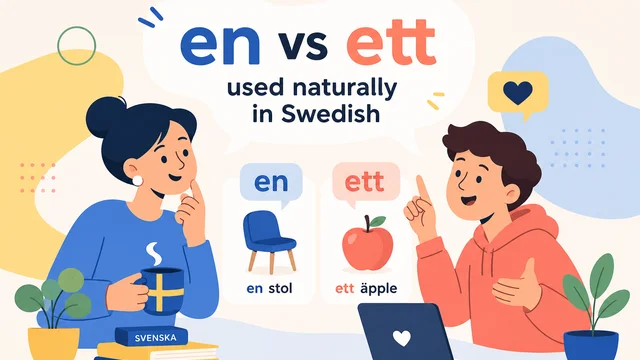
Learn Swedish articles: en, ett, and definite endings
How to understand Swedish grammatical gender, when to use each article, and the patterns that make guessing feel reliable.
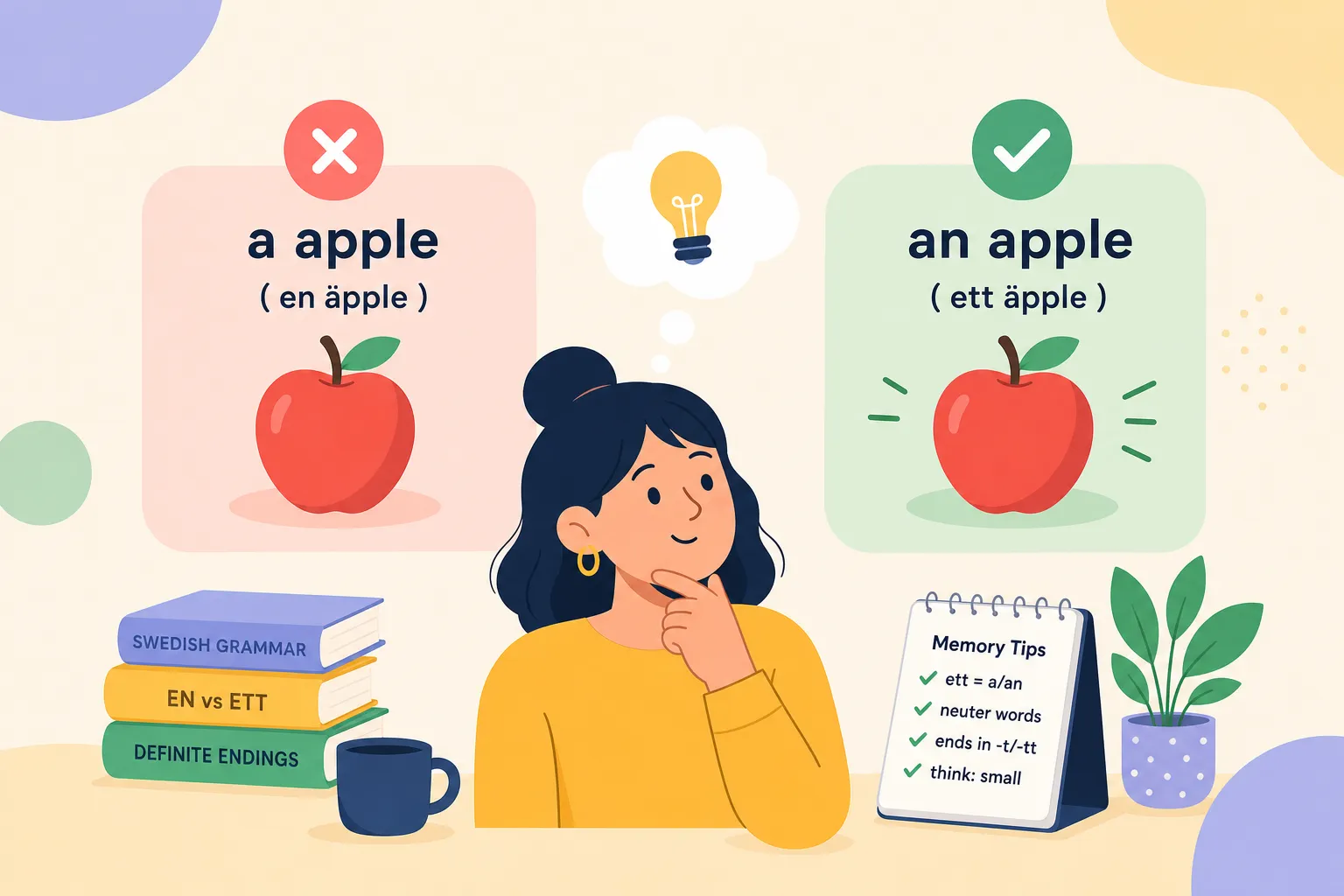
You're trying to say "a house" in Swedish. You've looked up the word: hus. Simple enough. But then you realize you need an article in front of it, and suddenly you're stuck. Is it en hus or ett hus? Nothing in English helps you here. English uses "a" for everything, and you've never once had to think about what grammatical category a house belongs to. So you guess. You say en hus and move on, hoping nobody notices.
If that sounds familiar, you're not struggling because you're bad at languages. You're struggling because Swedish asks something of English speakers that English never asks of itself. The good news is that this confusion has a shape, and once you see the shape, it becomes manageable. This guide breaks down how en and ett work, how definite endings follow from them, and what patterns you can actually use to make educated choices instead of random ones.
Why Swedish articles confuse English speakers from day one
English dropped grammatical gender centuries ago
Modern English uses "a" or "an" for every noun, regardless of what the noun describes. A book, a house, a car, a problem: the article never changes. Swedish works differently. Swedish nouns belong to one of two genders: common (called utrum) and neuter. The indefinite article changes depending on which gender a noun belongs to, and that gender distinction runs through the entire language. It affects articles, definite endings, adjective agreement, and the pronouns used to refer back to a noun. This is not a small quirk you can ignore at the intermediate level; it's structural.
Why random guessing stops working as your vocabulary grows
For the first handful of nouns you learn, rote memorization works fine. You learn en bil as a chunk, and you remember it. But once your vocabulary grows to several dozen words or more, that approach starts to collapse under its own weight. There are too many words to hold individually, and without a system, your confidence in each article choice stays stuck at "I think it's en?" The good news is that patterns exist. Swedish noun gender is not randomly assigned across the board; certain endings are strong predictors, and understanding them changes the way you study.
How to learn Swedish articles: the en/ett distinction
En-words are the majority
Roughly 75 to 80 percent of Swedish nouns are en-words, according to corpus-based estimates from Swedish grammar research. That's the most important statistical fact you can internalize, because it means en is a reasonable default. When you encounter a noun you haven't studied and need to make a call, guessing en will be right most of the time. Common en-words include en bil (a car), en bok (a book), en hund (a dog), and en stol (a chair). Because the majority of nouns fall into this category, your real study target is the minority: ett-words.
Ett-words are the set you need to learn deliberately
Ett-words make up roughly 20 to 25 percent of Swedish nouns, but they appear constantly in everyday speech. Core examples include ett hus (a house), ett barn (a child), ett bord (a table), ett problem (a problem), ett år (a year), and ett namn (a name). The practical strategy is to assume en unless you've specifically learned that a noun is ett. Build your dedicated ett-word list from high-frequency nouns, because those are the ones you can't safely guess.
Learn the article as part of the noun, not separate from it
This habit is the single most useful shift you can make when learning Swedish articles. The article is not a label you attach later; it is part of how the word is stored in Swedish. When you encounter a new noun, learn it as en bil or ett hus, not just bil or hus. This rewires how you store vocabulary and pays off every time you need to produce the definite form, because the definite ending follows directly from the article.
How Swedish definite endings work
Definiteness is built into the noun itself
Swedish marks "the" by adding a suffix to the noun rather than placing a separate word in front of it. En-words take the definite suffix -en or -n: bil becomes bilen (the car), bok becomes boken (the book), hund becomes hunden (the dog). Ett-words take the definite suffix -et or -t: hus becomes huset (the house), bord becomes bordet (the table), barn becomes barnet (the child). Once you know whether a noun is en or ett, the definite form follows automatically. For a concise reference on articles and definite forms in Swedish, see WordDive's guide to Swedish articles.
When an adjective appears, Swedish uses double marking
Add an adjective before the noun and Swedish introduces a separate definite article in front: den for en-words, det for ett-words. But the suffix stays on the noun too. So you get den röda bilen (the red car) and det stora huset (the big house). This is called double definiteness, and it looks strange to English speakers at first. It becomes predictable once you recognize it as a fixed pattern: article plus adjective in the -a form plus noun with its definite suffix. In the plural, the pattern continues: de stora bilarna, de stora husen. The adjective's -a ending holds across most definite constructions, though note that after possessives and certain determiners like min, din, or nästa, Swedish grammar handles agreement differently. For a clear explanation of this phenomenon, read Transparent Language's explanation of double definiteness.
Suffix patterns that cut the guesswork
Suffixes that reliably signal en-words
Several derivational endings are strong predictors of common gender. Nouns ending in -het are almost always en-words: en frihet (a freedom), en säkerhet (a safety), en möjlighet (a possibility). Nouns ending in -ning follow the same pattern reliably: en tidning (a newspaper), en övning (an exercise), en mening (a sentence or opinion). Agent nouns ending in -are are also en-words: en lärare (a teacher), en säljare (a salesperson). These patterns alone cover a significant chunk of abstract and occupational vocabulary, so learning them is efficient. For a broader overview of common patterns, see OnlineSwedish's overview of Swedish nouns.
Patterns that point toward ett-words
Many short, high-frequency everyday nouns with no distinctive derivational ending tend to be ett-words: ett hus, ett bord, ett barn, ett år, ett rum. Loanwords ending in patterns like -ment, -eri, or -um have a higher likelihood of being ett-words as well. Nouns whose plural form is identical to the singular (no ending change) are often neuter. These are rules of thumb, not guarantees. Exceptions exist, and that's normal in any language with grammatical gender. The goal is to make better guesses more often, not to eliminate uncertainty entirely.
The definite form as a reverse-lookup trick
When you're reading Swedish and you encounter a definite noun, you can work backward to identify its gender. If the noun ends in the definite suffix -et or -t, it's an ett-word. If it ends in -en or -n, it's an en-word. Actively noticing definite endings in texts you read is one of the fastest ways to reinforce gender associations, because you're seeing real usage rather than abstract rules.
Memory tricks and study tools
Mnemonics and learning nouns as complete units
Associating a vivid mental image with both the noun and its article locks the pairing into long-term memory much more effectively than reading the article once and hoping it sticks. Color-coding your vocabulary notes - one color for en-words, another for ett-words - creates passive reinforcement every time you review. Writing example sentences that use both the indefinite and definite forms in a single pass cements both patterns at once: Det är ett hus. Huset är stort. For concrete practice techniques, check out 12 Tips for Swedish Learners.
When you want a system, not just a list
At some point, memorizing one noun at a time stops being efficient. You need to internalize the underlying patterns so that new nouns feel familiar rather than arbitrary. Artikulera was built specifically for this problem. It organizes a large bank of Swedish nouns around learnable rules of thumb and uses spaced repetition to surface nouns right before you'd forget them. Read more about the benefits of spaced repetition from Hacking Chinese's article on spaced repetition. A timed challenge mode is designed to push words from "I sort of remember" to "I just know" - the real goal for Swedish articles: not slow retrieval, but automatic instinct.
Practice exercises that make learning Swedish articles feel automatic
Retrieval drills that build automatic recall
The most effective drill is simple: see a noun, produce the article before it without hesitation. Fill-in-the-blank exercises where you insert en, ett, or the correct definite form force retrieval under pressure, which strengthens memory more than passive review. Start with high-frequency nouns: ett barn, en bok, ett hus, en bil. Get those automatic before expanding to specialized vocabulary.
The sequence matters because automaticity with common words frees up mental capacity for everything else in a sentence. Research on spaced repetition consistently shows that retrieving information at increasing intervals outperforms massed review for long-term retention - a principle that applies directly to drilling Swedish article rules.
Reading and listening for real-context reinforcement
Graded Swedish texts are valuable because they show articles in natural sentence flow rather than isolation. When reading, actively notice every definite ending you encounter and check whether it matches your expectation based on the gender you've learned. Podcast-style content that includes grammar commentary helps reinforce article forms through repeated spoken exposure. The combination of reading, listening, and drilling covers the full range of how Swedish articles appear in real use: seen, heard, and produced under pressure.
The article system is strange until it isn't
Learning Swedish articles is one of those things that feels impossible at first and genuinely predictable later. The shift happens gradually, through accumulated exposure and deliberate practice, not through a single breakthrough moment. Here's the system to hold onto:
- En is the default for roughly 75 to 80 percent of nouns.
- Build a solid working list of common ett-words and drill them first.
- Learn definite endings as part of each noun from the beginning.
- Use suffix patterns as shortcuts that sharpen your guesses over time.
Every noun you learn with its article attached is a small compound victory. En bil. Bilen. Den röda bilen. Each of those forms follows from the gender, and the gender follows from a system you're building piece by piece. Those small wins accumulate into something that starts to feel like fluency. If you want to make the process faster and more systematic, Learning Swedish: Where to Begin is worth reading next.
For a deeper look at why learners find these patterns deceptively difficult, see Why Swedish is Harder Than It Looks.

Practice Swedish en/ett with Artikulera
Spaced repetition, 30 rules of thumb, and 4,500+ nouns. Free to download.
Free · iPhone & iPad · iOS 17.6+
Frequently asked questions
- How do I know when to use en or ett in Swedish?
- Swedish nouns belong to two genders: common (utrum) and neuter, and the indefinite article changes depending on which gender a noun has. There is no single English equivalent rule, but patterns and word endings can help you predict gender, and when unsure you can default to en since it is the majority case.
- Is it safe to always guess en for new Swedish words?
- Yes - roughly 75-80% of Swedish nouns are en-words, so guessing en will be right most of the time. However, learn high-frequency ett-words deliberately, because the minority of nouns that are ett appear often in everyday speech.
- Which ett-words should I memorize first?
- Start with high-frequency, core ett-words because they are the ones you cannot safely guess: examples include ett hus, ett barn, ett bord, ett problem, ett ar, and ett namn. Build a dedicated list of common ett nouns and practice them as chunks.
- What's the best way to study articles so I stop guessing?
- Learn the article as part of the noun - for example, store en bil or ett hus rather than just bil or hus. This habit makes production easier and immediately tells you the correct definite ending and agreement patterns.
- Do en and ett affect other parts of Swedish grammar?
- Yes - the gender distinction influences definite endings, adjective agreement, and which pronouns are used to refer back to a noun. It is a structural feature of the language, not a superficial quirk you can safely ignore.
- Why do English speakers find Swedish articles so confusing at first?
- Modern English dropped grammatical gender, so English speakers are not used to choosing different articles for different nouns. At first you can memorize a few chunks, but random guessing breaks down as your vocabulary grows because Swedish requires consistent gender decisions across grammar.
- Will learning noun endings help me predict whether a word is en or ett?
- Yes - corpus research shows certain endings are strong predictors of gender, so recognizing those patterns makes educated guessing far more reliable. Combine pattern awareness with memorizing high-frequency ett-words and treating the article as part of the noun to get the best results.