12 tips for Swedish learners
These are the pieces of advice that make the biggest difference - not for people who have unlimited time, but for people who want to make real progress in a reasonable amount of time.
Learn en/ett from day one - never without it
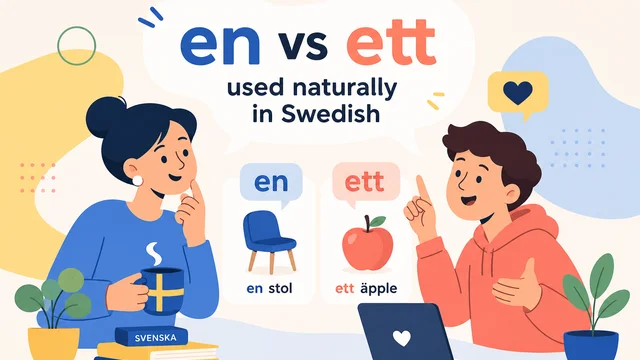
Write every noun with its article: never just hund, always en hund. Never just bord, always ett bord. The gender cascades into definite forms, adjective agreement, and pronouns. Fix the habit early and everything else gets easier. Re-learning the gender of a familiar word later is genuinely hard.
Use the 30 rules of thumb, not brute memorization
Before memorizing individual nouns, learn the 30 patterns that predict gender: suffixes like -het, -ing, -tion, -ism, and semantic categories like animals, drinks, and plants. These rules cover ~80% of Swedish nouns. Brute-force memorization without rules is slow; rules without practice is equally slow. Combine them.
Consistency beats intensity
Twenty minutes every day beats three hours on Sunday. Spaced repetition algorithms - the technology behind Artikulera and Anki - only work if you show up regularly. The review schedule is optimized for daily use; skipping days degrades the system and forces re-learning.
Fix pronunciation in month one, not month twelve
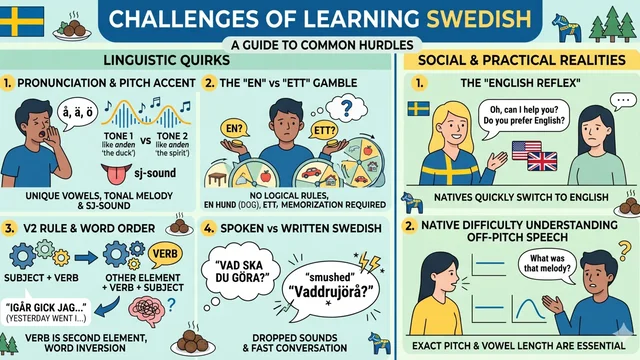
Swedish tonal accent (the pitch patterns that distinguish tomten 'the garden gnome' from tomten 'Santa Claus') is genuinely hard to fix once your ears have adapted to ignoring it. Spend your first month on pronunciation. Listen to native speakers on Forvo, use Speechling for feedback, mimic Swedish radio presenters. It will pay dividends forever.
Don't translate - think in Swedish
Translating from English to Swedish in your head introduces English word order (which differs from Swedish), English idioms (which don't transfer), and creates a processing delay that makes conversations feel impossible. Practice producing simple Swedish sentences directly from Swedish thoughts, not English ones translated on the fly.
Use subtitles strategically
Swedish TV with Swedish subtitles is one of the best learning tools available. The audio reinforces pronunciation while the text reinforces spelling and vocabulary. Start with easy Swedish (children's programming, slow-paced dramas) and graduate to fast-paced dialogue as your comprehension grows. SVT Play is free worldwide.
Speak early and speak often
Many Swedish learners wait until they feel 'ready' to speak. This day never comes on its own. Speaking from the beginning - even badly - builds the phonological motor memory that silent study can't. Find a language exchange partner (Tandem, HelloTalk) or book a tutor on iTalki. Swedes are almost universally patient and encouraging with learners.
Learn the most common words first
The 1,000 most frequent Swedish words cover ~85% of everyday text. The next 4,000 cover another ~5%. Focus your early energy on high-frequency vocabulary. Our 1,000-word en/ett guide covers the most common nouns with their gender, definite form, and plural.
Read simple Swedish content every day
8 Sidor (easyswidish news), Swedish Wikipedia (simplified version), and Swedish children's books provide authentic input at a manageable level. Reading reinforces vocabulary in context, builds intuition for sentence structure, and exposes you to Swedish you'd never see in a textbook.
Use a dictionary with example sentences
When you look up a Swedish word, always read the example sentences - not just the translation. Context is how meaning is actually stored in memory. Lexin (lexin.se) and Folkets lexikon both provide examples. SAOB is authoritative but more advanced.
Track your progress visibly
Language learning has an invisible middle phase where you feel like you're not improving, even as you are. Use tools that make progress concrete: a word count in Artikulera, a reading log, a weekly speaking session. Visible progress prevents the motivation dips that derail most learners.
Embrace the plateau
Every language learner hits a plateau at around B1 level, where basic communication is possible but fluency feels distant. This is the most important moment to keep going. The plateau is not a sign that you've stopped improving - it's a sign that growth has become more subtle. Stay consistent, seek harder input, and trust the process.

Practice Swedish en/ett with Artikulera
Spaced repetition, 30 rules of thumb, and 4,500+ nouns. Free to download.
Free · iPhone & iPad · iOS 17.6+