How native Swedish speakers use en and ett naturally
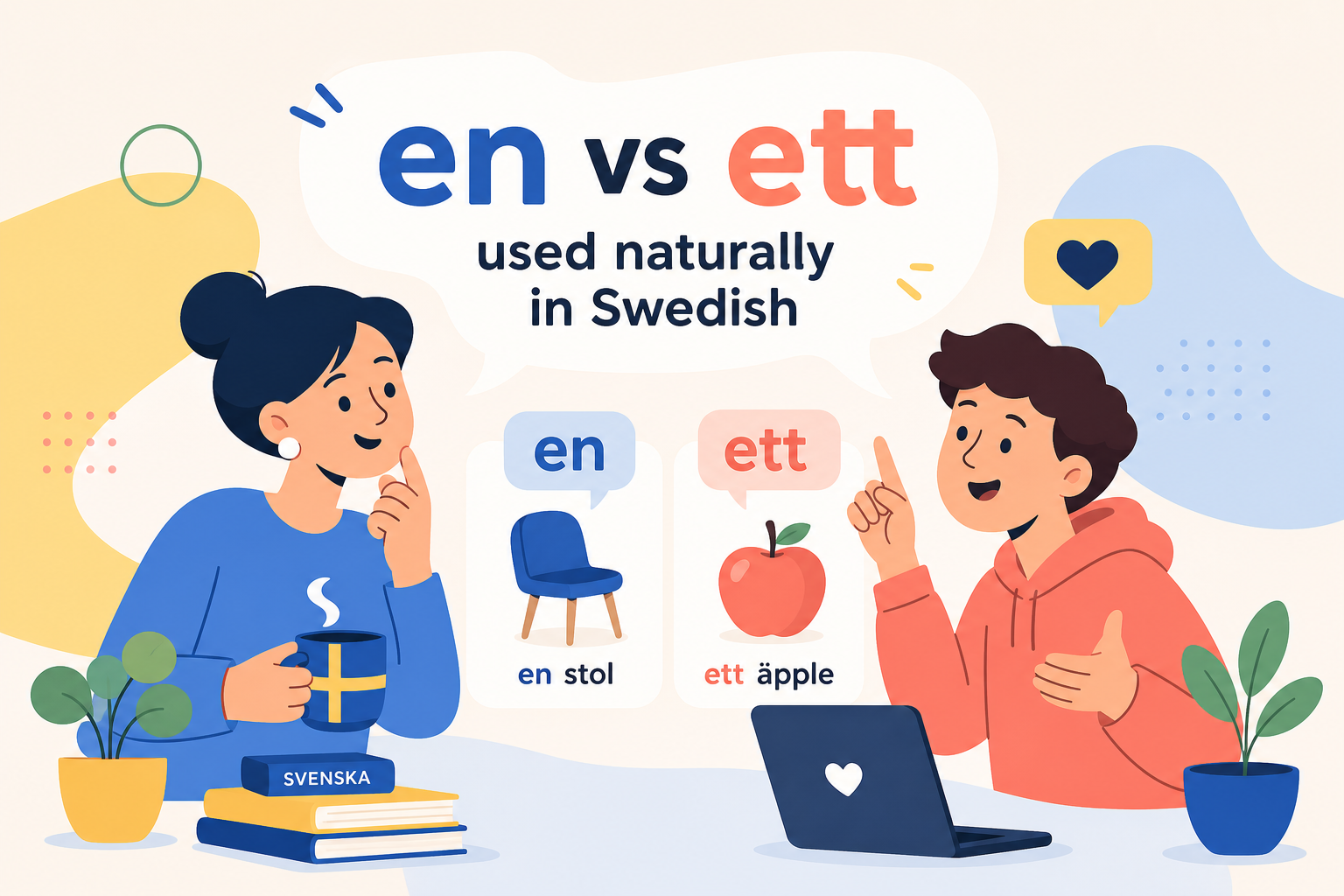
I remember standing in a Swedish supermarket, pointing at something on a shelf and starting to say "Jag köper..." then freezing completely. Ett? En? I knew the word. I'd studied it. But in that split second, with someone waiting behind me, the rule just evaporated. I said "en" and it was wrong. My face went warm.
That moment taught me something important: knowing a rule and using it at conversation speed are completely different skills. Fluent Swedish speakers rarely pause mid-sentence to run a grammar check - the answer arrives before the question. So how do native Swedish speakers use en and ett naturally, without thinking? And more importantly, how can you get there too?
The goal here is to help you build that same feel for en and ett in everyday speech - not just accuracy, but actual speed. We'll walk through the patterns you can trust, cover when to drop the indefinite article entirely, and talk about how to train your brain until the right answer arrives before you've consciously thought about it. At Artikulera, we designed drills specifically to make this click fast, not just correctly.
How do native Swedish speakers use en and ett naturally?
What kids hear: frequency, chunks, and gentle correction
Swedish children don't learn a list of endings and exceptions. They hear "en bok" and "ett hus" thousands of times before they can read, absorbing the article as part of the word's identity rather than as a separate grammar rule. When they make a mistake, a parent gently corrects them and the correct chunk gets reinforced. Usage-based accounts of first-language acquisition suggest that input volume builds intuition well before explicit grammar takes hold, and that's worth remembering when you feel frustrated about memorizing gender.
The practical implication for adult learners is that you need to store words in chunks, not in isolation. Not "bok" but "en bok." Not "hus" but "ett hus." Every time you encounter a new noun, attach the article immediately, like a last name that belongs to that word. Research on phrase-based vocabulary learning supports this approach: storing collocations rather than bare words improves both recall and fluency over time.
Category cues that guide fast guesses
Native speakers lean on morphology and meaning without consciously naming them. When a Swedish speaker hears a new loanword like "kaféet" in the definite form, it sounds right because it patterns with other neuter words they've absorbed over a lifetime - they're using analogy, not explicit rules. Linguists call this morphological analogy: a new word "sounds like" an established category, and the brain extends the pattern automatically. Think of how an English speaker instantly knows "the glurp" sounds singular even though "glurp" is invented. Your brain can learn these Swedish cues deliberately, even if it can't apply them automatically at first. A useful contrast: a learner who hasn't internalized the pattern might say "en kafé" because the word feels borrowed and light, while a native speaker's ear flags "kaféet" as neuter and adjusts instantly.
Speed before grammar rules
Fluent speakers almost never think about rules during speech because the answer arrives before conscious reflection kicks in. Consider a native speaker reaching for "bordet" - they don't think "neuter definite singular," they just say it. As a learner, you reverse this process: start with explicit rules, drill them, then practice at speed until the rule fades into background knowledge and only the answer remains. That's the whole game, and it's a learnable one.
Rules you can trust to predict en vs ett
The 75/25 split and a smart default
Roughly 75% of Swedish nouns are en-words and about 25% are ett-words. Corpus-based estimates from Swedish noun databases put the split at approximately 74% en and 26% ett, close enough to a three-quarters majority to be genuinely useful as a heuristic. Default to en, confirm with form clues. This single habit reduces your error rate before you've memorized a single pattern, and it gives you a confident starting position instead of a blank. Note that this figure comes from vocabulary databases rather than from an authoritative grammar like Svenska Akademiens grammatik, so treat it as a useful rule of thumb rather than a precise linguistic law.
Definite and plural clues that almost shout the gender
The most reliable cues come from the definite singular ending and the plural shape. Definite ends in -en or -n: almost certainly an en-word. Boken (en bok), kartan (en karta), stolen (en stol). Definite ends in -et or -t: almost certainly an ett-word. Huset (ett hus), kaféet (ett kafé), bordet (ett bord).
Plurals carry the same signal. Endings in -or, -ar, -er reliably indicate en-words: flickor (en flicka), tidningar (en tidning), böcker (en bok). An unchanged plural or one adding -n reliably indicates ett-words: hus (ett hus), barn (ett barn), äpplen (ett äpple). When you see or hear a noun in its definite or plural form, you're looking at strong evidence about which article to use. For step-by-step plural rules and examples, check this practical guide to plural endings in Swedish.
Productive endings that tip the scales
Some noun endings carry a strong gender signal even in the indefinite singular. Nouns ending in -a are almost always en-words with -or plurals: en flicka, flickor; en klocka, klockor. Nouns ending in -ing or -ning are en-words with -ar plurals: en tidning, tidningar; en mening, meningar.
Consonant-final nouns that take -er in the plural are typically en-words, even when the plural is irregular: en bok, böcker; en stad, städer. Vowel-final ett-words add -n in the plural: ett äpple, äpplen. Endings predict both article and plural shape. Learn one form and the other often follows.
A few traps and exceptions worth learning early
Some of the most common Swedish nouns are also the most irregular. En bok becomes böcker, not bokar. En stad becomes städer, not stader. Ett öga has the plural ögon. Nouns ending in -are, like en lärare, are virtually always en-words, but their plural is unchanged: lärare. These are worth flagging early precisely because they appear constantly. The umlaut shifts in bok and stad follow a recognizable pattern once you've seen a few examples, though they still require deliberate memorization at first.
Sound natural: when to skip the article in Swedish
Once you know which article to use, the next question is when not to use one at all - and this is where many learners sound unnaturally foreign even after mastering the en/ett split.
Professions and roles after vara
When you identify someone by their profession after "vara" (to be), Swedish drops the indefinite article entirely. Han är lärare. Hon är läkare. De är studenter. No article needed. In English, you say "he is a teacher," which makes the Swedish version feel incomplete at first, but it's correct and natural.
The article comes back when you add a modifier or treat the title as a count noun rather than a role label. Han är en skicklig lärare means "he is a skilled teacher," and the en is necessary because skicklig turns the phrase into a description rather than just an identification. Role label = no article; description = use en/ett. This distinction is clean once you see it a few times.
Nationalities, religions, and similar labels
The same logic applies to nationalities and group identities. Hon är svensk. Han är muslim. No article. But as soon as you add evaluation or specificity, the article returns: Hon är en stolt svensk, "she is a proud Swede." The adjective stolt shifts the noun from a neutral label to a characterized one. Practice these pairs until the contrast becomes automatic.
Other everyday omit-or-include patterns
Indefinite plurals take no article at all, so "Jag köper böcker" is correct without any article before böcker. Demonstratives replace the article entirely: den här boken, not "en den här boken." Possessives work the same way: min bok, not "en min bok." These feel obvious once you know them, but learners often insert a redundant article out of English habit.
From rules to reflex: turn knowledge into instinct
Why spaced repetition must target response time
Here's the uncomfortable truth: you can know the rule for en and ett perfectly well and still freeze in conversation. The gap between knowing and doing is almost entirely a question of retrieval speed. Speedy recall beats slow correctness in real speech because hesitation breaks fluency, and fluency is what makes you sound natural. Spaced repetition helps, but only if you're tracking how fast you retrieve answers, not just whether they're correct. This reflects a widely held view in second-language acquisition research: automaticity, not just accuracy, is what distinguishes fluent performance from effortful recall.
Timed micro-retrieval and interleaving
Short, mixed noun sets force your brain to apply gender cues flexibly rather than pattern-matching within a single category. When you jump from ett hus to en bok to ett äpple to en tidning, you can't coast on context. The slight time pressure mirrors the cognitive conditions of actual conversation, which trains exactly the response speed you need.
How Artikulera engineers this transition
Artikulera is built around the idea that instinct, not just knowledge, is the target. Its timed mastery system rewards fast, intuitive en/ett recall rather than slow accuracy: each noun climbs toward a higher rating as your response time drops, so you can watch instinct forming in real time. The vocabulary library spans thousands of nouns spread across multiple practice modes covering article choice, definite suffix, and plural ending. Rather than presenting rules as a list, the app groups them into thematic patterns, each with its own progress tracker, so you can see which categories feel solid and which still need work. The goal throughout is to push familiar nouns from memorized into genuinely automatic - the same transition native speakers made years ago through sheer exposure. For a complementary perspective and extra drills, see this strategic guide to mastering en and ett.
What progress feels like at 2 and 4 weeks
Many learners who practice consistently report a recognizable arc: accuracy tends to improve in the first week, response time begins dropping in the second, and by weeks three and four the correct article often arrives before conscious thought - a feeling that also starts to generalize to unfamiliar nouns. These are typical patterns rather than guaranteed outcomes, and individual results will vary. Useful things to track along the way: how often you answer correctly within about two seconds, how your average response time shifts across sessions, and which rule categories still feel slow. When a category starts feeling effortless, that's a sign the pattern has moved from memory into reflex.
Practice plan: 10 minutes a day to sound native-fast
1. Set your default and prep your brain
Start every session with a 60-second mental warm-up: en is your default, and you'll upgrade it when you spot a clear ett clue like -et in the definite or an unchanged plural. One confident default reduces hesitation by giving you a starting position rather than a blank. Commit to en unless something tells you otherwise, then move fast.
2. Core drill block in Artikulera
Five minutes of timed en/ett sprints mixing familiar and new nouns. Respond as if you're speaking aloud, not reading carefully. Accept a miss, check the correct form, and move on without dwelling. The spaced repetition algorithm will resurface that noun at the right interval to fix it.
3. Deepen the system with forms
Add definite and plural prompts to your drill rotation: huset, boken, flickor, äpplen. Each form reinforces the connection between the indefinite article, the definite suffix, and the plural ending. When all three feel linked, gender becomes a system rather than a list of isolated facts.
4. Anchor the habit and track gains
Use Artikulera's daily reminders and home screen widgets to keep the habit alive on low-motivation days - consistency matters more than session length. Set a weekly checkpoint: aim for strong accuracy on timed drills, then gradually tighten your response time target. Watching that number drop is more motivating than it sounds.
Try it now: micro-tests with native-style sentences
Quick guesses in context
Fill in en or ett for each blank, then check the answer in parentheses.
- Jag köper ___ bok. (en)
- Vi målade ___ hus. (ett)
- Hon dricker kaffe på ___ kafé. (ett)
- Han köpte ___ stol till kontoret. (en)
- Vi hittade ___ äpple på bordet. (ett)
- Det finns ___ tidning på stolen. (en)
- De bor i ___ stad vid havet. (en)
- Jag ser ___ lärare i korridoren. (en)
- Vi äger ___ bil och ___ hus. (en, ett)
- Det är ___ bra barn. (ett — "It is a good child")
Role predicates vs count-noun contrast
These pairs show the article-omission rule in action. Notice what changes and why.
- Han är lärare. (neutral role label, no article) vs. Han är en bra lärare. (adjective present, article required)
- Hon är svensk. (nationality label, no article) vs. Hon är en stolt svensk. (described, article required)
- De är studenter. (plural role label, no article) vs. De är engagerade studenter. (adjective present, still no article because plural)
The pattern is consistent: as soon as a modifier turns the noun from a label into a description, Swedish pulls the article back in.
Your next step
Choose three ett-clues to watch for this week. The definite -et ending is the easiest starting point: every time you see a word like huset, bordet, or kaféet, you're looking at an ett-word. For further reading on common en/ett patterns, see this clear overview of en or ett continued. Build from there. Then open Artikulera, run a timed session, and pay attention to how fast you're responding rather than just whether you're right. That shift in focus - from correctness to speed - is exactly where instinct starts forming. It's the same transition that answers the question of how native Swedish speakers use en and ett naturally: not through rules they recite, but through patterns they've stopped noticing.

Practice Swedish en/ett with Artikulera
Spaced repetition, 30 rules of thumb, and 4,500+ nouns. Free to download.
Free · iPhone & iPad · iOS 17.6+
Frequently asked questions
- How do native Swedish speakers pick en or ett without thinking?
- Native speakers store article+noun chunks from massive exposure, so the correct article arrives before conscious thought. They use analogy, morphology and meaning automatically rather than running a grammar check during speech. The article gives the example of a speaker reaching for "bordet" without thinking "neuter definite singular."
- What's the fastest way for a learner to start using en/ett naturally?
- Attach the indefinite article to every new noun as you learn it (for example, store "en bok" not just "bok"). Drill those chunks at conversational speed until the choice fades into background knowledge, turning explicit rules into automatic responses. The article argues this phrase-based approach improves recall and fluency.
- Can I just default to en and be mostly correct?
- Yes - about 74% of Swedish nouns are en-words, so defaulting to en is a smart heuristic that reduces errors. The article recommends using en as a starting guess and then confirming with morphological or meaning cues when possible.
- Are there clues that help you guess whether a noun is ett?
- Yes - native speakers rely on morphology and analogy: a new word that patterns with known neuter words will sound like ett. The article points to loanword patterns like "kaféet" versus a learner's mistaken "en kafé" as an example of how analogy guides fast guesses.
- Why do children learn gender more easily than adult learners?
- Children hear article+noun combinations thousands of times and receive gentle correction, so the correct chunk becomes part of the word's identity before explicit grammar is learned. Usage-based acquisition research cited in the article shows that input volume builds intuition faster than studying lists of rules.
- How should I practice if I make mistakes or freeze in conversation?
- Practice speeded drills that mimic real-time speech so you stop relying on conscious rule-checking; the article emphasizes training until the right article appears before you think about it. Also adopt phrase-based learning and accept corrective feedback to reinforce the correct chunks.
- What role do drills and courses like Artikulera play in learning en/ett?
- The article describes drills designed at Artikulera to build automaticity quickly, not just correctness. Repeated, speed-focused practice of article+noun chunks helps shift knowledge from explicit rules into fluent, unconscious use.