The truth behind Swedish en and ett
It looks arbitrary - but it isn't. Here's where grammatical gender comes from, why Swedish kept two categories, and why learning it is much more learnable than it seems.

Where gender came from
Modern Swedish is descended from Proto-Germanic, the ancestor of all Germanic languages - English, German, Dutch, Norwegian, Danish, and more. Proto-Germanic had three grammatical genders: masculine, feminine, and neuter. Every noun belonged to one of these classes, and articles, adjectives, and pronouns all had to agree with the noun's gender.
Over roughly a thousand years, the Scandinavian branch of Germanic simplified this system. Masculine and feminine - which had always overlapped significantly - merged into a single category called utrum (common gender), marked by the article en. Neuter survived essentially unchanged, marked by ett.
The result is the two-gender system you see today. En is the common gender (roughly "people and things that used to be masculine or feminine"). Ett is the neuter gender (roughly "things that were already neuter").
Why doesn't English have this?
English underwent the same merging process - but went further. Old English had three genders; Middle English eliminated grammatical gender almost entirely, keeping only natural gender (he/she/it based on biological sex). Scandinavian languages kept the distinction between common and neuter because they underwent the merger but not the elimination.
This is why en/ett is so difficult for English speakers: English has had no grammatical gender for ~600 years, so the concept feels foreign rather than simplified.
Is it actually random?
No - though it can feel that way at first. About 75–80% of Swedish nouns are en-words, and roughly 30 patterns make the gender predictable:
- 26 suffix rules - nouns ending in -het, -ing, -are, -tion, -ism, etc. are almost always en-words; nouns ending in -um, -ment, -gram are almost always ett-words.
- 4 semantic rules - animals and people, drinks, plants/trees, and time units are almost always en-words.
- 1 compound rule - compound nouns inherit the gender of their final component.
The nouns that don't follow any pattern are the minority, and even among them, many can be grouped by word origin (loanwords from Latin or French tend toward en; old Norse neuters tend toward ett).
What about the definite form?
In Swedish, the definite article isn't a separate word - it's a suffix added to the noun. The suffix depends on gender:
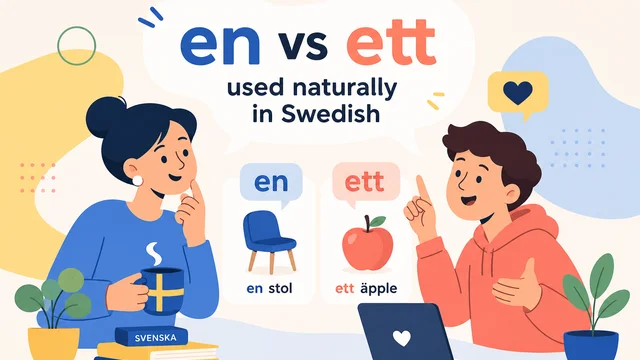
- en hund (a dog) → hunden (the dog) - en-words add -en
- ett bord (a table) → bordet (the table) - ett-words add -et
Get the gender wrong and the definite form sounds unnatural. This is why en/ett isn't just a trivia question - it cascades into every sentence that uses the definite form, and into pronoun choice (den vs det).
The practical takeaway
Learning Swedish gender is not about memorizing arbitrary labels. It's about recognizing patterns, building intuition through exposure, and filling in the exceptions with deliberate practice. The 30 rules of thumb in Artikulera cover the vast majority of the language - and spaced repetition handles the rest.
If you can predict gender for 80% of words from rules alone, and drill the remaining 20% with a good flashcard system, you'll sound natural in Swedish far sooner than you expect.

Practice Swedish en/ett with Artikulera
Spaced repetition, 30 rules of thumb, and 4,500+ nouns. Free to download.
Free · iPhone & iPad · iOS 17.6+
Frequently asked questions
- Why does Swedish have en and ett?
- Swedish, like all Germanic languages, descends from Proto-Germanic, which had three genders: masculine, feminine, and neuter. Over centuries, Scandinavian languages merged the masculine and feminine categories into a single 'common' gender (utrum), marked by en. The neuter gender survived as ett. So Swedish en/ett is essentially a two-gender remnant of an older three-gender system.
- Is there a logical reason for which nouns are en vs ett?
- Partly. Around 80% of the patterns are predictable: suffixes like -het, -ing, and -tion reliably signal en; semantic categories like animals, people, drinks, and plants are almost always en. The remaining unpredictable cases are largely due to historical accident - loanwords, archaic forms, and irregular inheritance from Old Swedish.
- How many Swedish nouns are en-words vs ett-words?
- Approximately 75–80% of Swedish nouns are en-words (common gender) and 20–25% are ett-words (neuter). This ratio means that defaulting to en is correct more often than not, but learning which nouns are ett is essential for fluency.
- Is Swedish grammatical gender similar to German gender?
- Structurally yes - both are Germanic systems descended from the same Proto-Germanic ancestor. But Swedish is simpler: two genders (en/ett) vs. German's three (der/die/das). Swedish also dropped almost all case marking, so gender mainly affects the article and definite suffix rather than the entire sentence structure.