Why Swedish is harder than it looks
On paper, Swedish is often considered one of the easier languages for English speakers to learn. It is a Germanic language, the grammar is relatively straightforward, and it has no complex verb conjugations - no matter who is doing the action, the verb stays the same.
But moving past the basics and achieving true fluency comes with some notoriously stubborn hurdles. Ask anyone who has tried to hold a real conversation in Swedish and you will hear the same stories. The challenges generally fall into two categories: linguistic quirks and social realities.
The linguistic hurdles
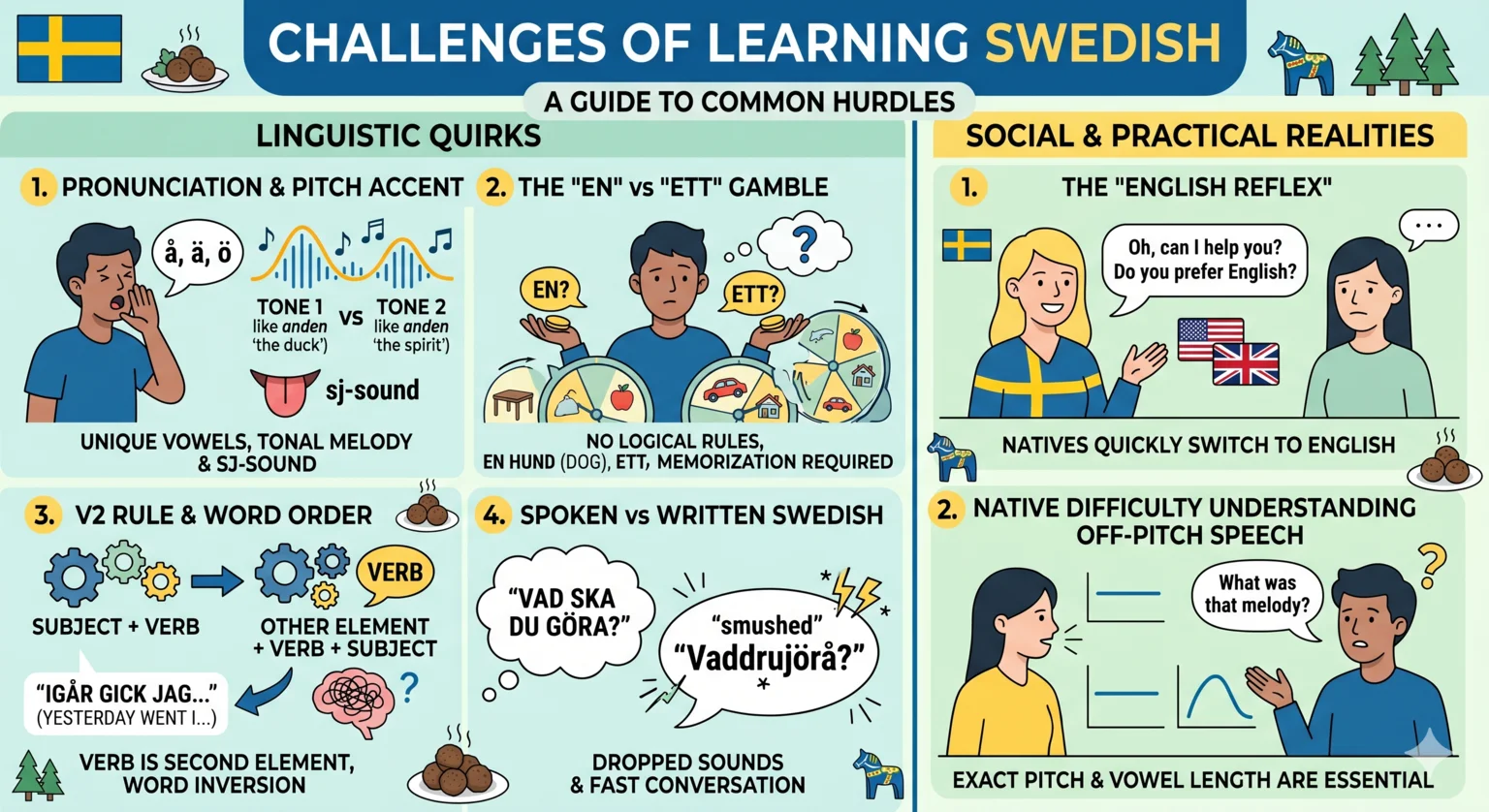
1. Pronunciation and pitch accent
Reading Swedish is fairly straightforward. Speaking it correctly is another story entirely.
The vowels. Swedish has nine vowels - including å, ä, and ö - and the distinction between long and short vowel sounds completely changes the meaning of a word. Väg means "way" and vecka means "week," and the difference is the vowel length, not just the letters.
Pitch accent. Swedish is a tonal language. It uses two distinct pitch accents - Accent 1 and Accent 2. If you do not get the rise and fall of your voice right, you can easily confuse words that are spelled exactly the same. For example, anden can mean "the duck" or "the spirit," depending entirely on your melody. Most European languages learners study do not work this way, which makes this feel like learning an entirely new skill on top of the vocabulary and grammar.
The sj-sound. The Swedish sj-sound - as in sjuksköterska (nurse) - is a unique, breathy fricative produced in the back of the throat. It does not exist in most languages and takes significant physical practice to master. Many learners still have not nailed it after years of study.
2. The en/ett gamble
Swedish nouns are divided into two genders: utrum (common words using en) and neutrum (neuter words using ett). About 75% of words are en-words, but there is no reliable logical rule to determine which is which. You simply have to memorize the gender along with the vocabulary.
This matters more than it might seem. The gender of a noun dictates how adjectives change form, how the definite suffix is formed, and how plurals are built. Get it wrong, and the mistake cascades through the rest of your sentence in ways that can make it genuinely difficult to understand.
There are 30 rules of thumb that cover a large share of common nouns, and they give you a real foothold. Nouns ending in -het, -ing, or -are are almost always en-words. Short monosyllabic words ending in a consonant often lean ett. Learning these patterns - and getting spaced repetition practice on the nouns they apply to - is how learners stop guessing and start building genuine intuition.
There is an app for this - it is called Artikulera. The app teaches all 30 rules of thumb with worked examples and tracks your progress on each one, so you can see which patterns are sticking and which need more repetition. As you practice, Artikulera's spaced repetition system surfaces nouns at the right moment - reinforcing the ones you are shaky on and gradually building the automatic recall that makes en/ett feel natural rather than effortful. There is no separate grammar worksheet to get through: the rules and the vocabulary practice are woven together, so pattern recognition builds alongside word knowledge. You can try the full app free - Artikulera offers a two-week free trial on the monthly plan and a full month free on the yearly plan.
3. Word order and the V2 rule
Swedish follows the V2 rule, meaning the finite verb must always be the second element in a main clause. If you start a sentence with anything other than the subject - a time expression, a place, an adverb - the subject and verb must swap positions.
- English: "Yesterday I went to the store."
- Swedish: Igår gick jag till affären. (Literally: Yesterday went I to the store.)
This inversion becomes automatic with enough practice - but it is disorienting at first, because it is not just a stylistic option in Swedish. It is a rule, and breaking it sounds wrong in a way that native speakers immediately notice.
The complication is that subordinate clauses (bisatser) follow completely different word order rules. An adverb like inte (not) appears before the verb in a subordinate clause but after it in a main clause. Keeping track of which clause you are in - and which word order applies - takes significant practice to internalize.
4. Spoken vs. written Swedish
Swedes are well known for smushing words together when they talk, dropping consonants, and taking shortcuts in casual conversation. A phrase like Vad ska du göra? (What are you going to do?) often sounds something like Vaddrujörå? to a learner hearing it for the first time.
Textbook audio - even well-produced textbook audio - is carefully enunciated in a way that real conversation never is. Many learners find they can read Swedish reasonably well and handle classroom exercises but freeze when they encounter actual spoken Swedish from a native speaker talking at normal speed. The jump from study to real-world listening comprehension is a genuine obstacle that takes specific practice to close.
The social and practical hurdles
5. The English reflex
The biggest barrier to learning Swedish - especially if you live in Sweden - is how well the locals speak English.
The moment a Swede detects a slight accent, a hesitation, or a look of confusion, they will instantly and flawlessly switch to English. They do this out of politeness and efficiency, but it deprives learners of the vital, real-world practice needed to improve. You practically have to fight to keep the conversation in Swedish.
This is often called the "English reflex," and it is not unique to Sweden - but Swedish English proficiency is particularly high, which makes the reflex especially hard to escape. A useful phrase for keeping conversations in Swedish: Kan vi tala svenska? Jag behöver öva. (Can we speak Swedish? I need to practice.) Most Swedes will understand and respect that directly.
6. Off-pitch Swedish is genuinely hard to understand
Because Swedish relies so heavily on exact vowel lengths and pitch melodies, native speakers are surprisingly poor at understanding Swedish spoken with a strong foreign accent. If your pitch accent is flat, a Swede might genuinely give you a blank look - not out of rudeness, but because their brains genuinely struggle to process the word without its correct musical tone.
This can be a significant blow to a learner's confidence. You have studied the grammar, you know the vocabulary, you construct a correct sentence - and you still get a blank look. Understanding that this is a feature of how Swedish is processed neurologically, not a social judgment, makes it easier to keep going. The fix is more speaking practice with feedback, not more grammar study.
These are learnable problems
None of these hurdles are insurmountable. Pitch accent improves with listening and imitation. The V2 rule becomes automatic with enough reading and conversation practice. The English reflex is manageable once you know to anticipate it and ask directly to keep things in Swedish.
And en/ett - perhaps the most persistently frustrating daily grammar obstacle - is completely learnable with the right system. Systematic exposure to the rules of thumb, combined with spaced repetition for individual nouns, is how most successful learners finally get it under control. Artikulera is built specifically for this: 4,500+ nouns, 30 rules of thumb with progress tracking, and timed practice modes that build the kind of automatic, fast recall that reading grammar explanations alone never produces. Download and try it free.

Practice Swedish en/ett with Artikulera
Spaced repetition, 30 rules of thumb, and 4,500+ nouns. Free to download.
Free · iPhone & iPad · iOS 17.6+
Frequently asked questions
- Is Swedish really that easy for English speakers?
- Swedish is easier than many languages - the grammar has no complex verb conjugations and the vocabulary has clear Germanic roots. But learners consistently hit several stubborn walls: pitch accent, the en/ett gender system with no logical rules, the V2 word order in main clauses with completely different rules in subordinate clauses, and the large gap between written and spoken Swedish. These make achieving real fluency harder than the easy-language reputation suggests.
- How long does it take to become fluent in Swedish?
- The US Foreign Service Institute classifies Swedish as a Category I language - roughly 600-750 classroom hours to professional working proficiency for English speakers. Real conversational fluency is often slower in practice, partly because Swedes tend to switch to English when they sense a learner struggling, which reduces real-world practice opportunities considerably.
- Why do Swedes keep switching to English when I try to speak Swedish?
- Swedes are among the most proficient non-native English speakers in the world, and they default to English out of politeness and efficiency the moment they detect hesitation or an accent. To keep the conversation in Swedish, try: "Kan vi tala svenska? Jag behöver öva" (Can we speak Swedish? I need to practice). Most Swedes will respect that directly.
- Is Swedish pitch accent really necessary to learn?
- Pitch accent is worth practicing but is not required for basic communication. Most Swedish learners at intermediate level communicate fine without perfect pitch. However, a completely flat pitch can make speech genuinely hard for native speakers to process - not out of rudeness but because the Swedish brain processes words partly by their melody. Even a rough feel for the difference between Accent 1 (falling) and Accent 2 (rising-falling) helps significantly.
- What is the V2 rule in Swedish?
- The V2 rule means the finite verb must always be the second element in a main clause. If you put anything before the subject - a time word like "igar" (yesterday) or a place - the subject and verb swap positions. "Yesterday I went" becomes "Igår gick jag" (literally: Yesterday went I). Subordinate clauses follow a completely different word order, which makes the rule feel inconsistent at first but becomes automatic with practice.
- How do I learn Swedish en and ett?
- Start by learning the 30 rules of thumb - patterns like nouns ending in -het, -ing, and -are being almost always en-words cover a large share of common vocabulary. Then reinforce with spaced repetition: learn each noun with its article from the start, and let a system surface the shaky ones at the right intervals until the choice becomes automatic. Artikulera is a Swedish learning app built specifically for en/ett - it teaches all 30 rules of thumb with examples, tracks your progress on each one, and uses spaced repetition across 4,500+ nouns. You can try it free for two weeks (monthly plan) or a full month (yearly plan).