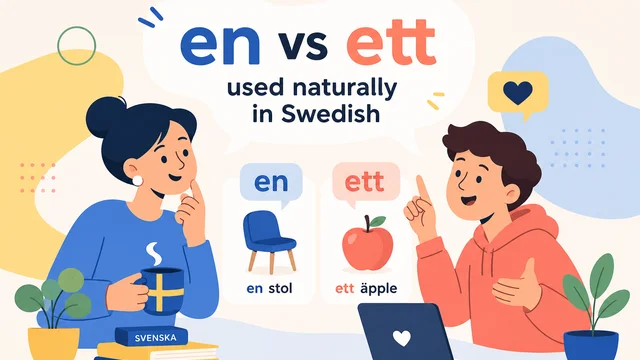
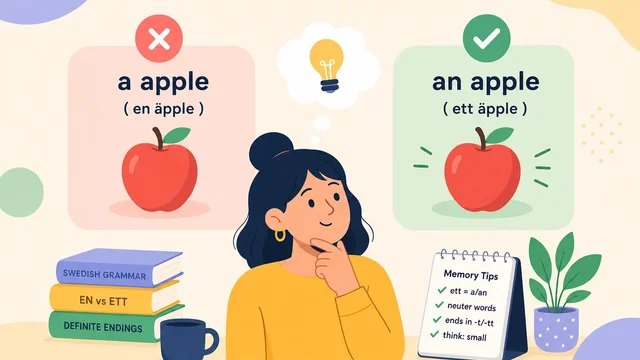
31 rules of thumb for Swedish en/ett
These patterns let you predict the gender of most Swedish nouns - even ones you've never seen before. No rules are perfect, but together they cover the vast majority of the language.
Suffix rules (26)
If a noun ends in one of these patterns, its gender is highly predictable. These rules alone let you correctly classify the majority of Swedish nouns.
Nouns ending in -het are almost always en-words
Nouns ending in -ing are almost always en-words
Nouns ending in -are are almost always en-words
Nouns ending in -tion or -sion are almost always en-words
Nouns ending in -ad are almost always en-words
Nouns ending in -um are almost always ett-words
Nouns ending in -ment are almost always ett-words
Nouns ending in -eri are almost always ett-words
Nouns with an unstressed -a ending are almost always en-words
Nouns ending in -ant or -ent are almost always en-words
Nouns ending in -dom are almost always en-words
Nouns ending in -lek are almost always en-words
Nouns ending in -else are almost always en-words
Nouns ending in -ik are almost always en-words
Nouns ending in -inna are almost always en-words
Nouns ending in -ism are almost always en-words
Nouns ending in -ist are almost always en-words
Nouns ending in -itet are almost always en-words
Nouns ending in -log are almost always en-words
Nouns ending in -nom are almost always en-words
Nouns ending in -när are almost always en-words
Nouns ending in -or are almost always en-words
Nouns ending in -ör are almost always en-words
Nouns ending in -gram are almost always ett-words
Nouns ending in -skop are almost always ett-words
Nouns ending in -tek are almost always ett-words
Semantic rules (4)
These rules apply based on what a noun means, regardless of how it ends.
Animals and people are almost always en-words
Units of time are almost always en-words
Drinks are almost always en-words
Plants and trees are almost always en-words
The compound-word rule
A compound noun takes the gender of its last component
Swedish freely combines nouns into compounds. The gender of the whole word is determined by the final element (the head): en bil + ett hus → ett bilhus. This rule applies universally and lets you confidently classify any compound noun once you know its components.
How to use these rules
The rules work best as a confidence booster for new words. When you encounter an unfamiliar noun:
- Check whether it ends in a recognizable suffix (most reliable).
- Check whether it refers to an animal, person, drink, plant, or time unit.
- If it's a compound, identify the final component and use its gender.
- If no rule applies, it's a memorization word - and there are far fewer of these than you think.
Artikulera's app teaches all 31 rules with radial mastery trackers, so you can see exactly how well you've internalized each pattern. Download it free and start training your intuition today.

Practice Swedish en/ett with Artikulera
Spaced repetition, 30 rules of thumb, and 4,500+ nouns. Free to download.
Free · iPhone & iPad · iOS 17.6+
Frequently asked questions
- How many rules of thumb are there for Swedish en/ett?
- Artikulera teaches 31 rules: 26 suffix-based rules (e.g. nouns ending in -het, -ing, -are), 4 semantic rules (animals/people, time units, drinks, plants/trees), and 1 compound-word rule (a compound noun inherits the gender of its head word).
- What is the most useful rule for Swedish noun gender?
- The single most useful rule is that 75–80% of Swedish nouns are en-words. When in doubt, guess en. Beyond that, the suffix rules are highly reliable: nouns ending in -het, -ing, -ning, -tion, -sion, -else, -ik, or -ism are almost always en-words.
- Are the rules of thumb always correct?
- No - they are heuristics, not laws. The rules cover the vast majority of Swedish nouns, but exceptions exist. For example, ett lejon (a lion) breaks the animal rule. The rules are most valuable as defaults: use them to make confident guesses, then memorize the exceptions.
- Do compound nouns follow a rule?
- Yes - Swedish compound nouns take the gender of their last component (the head word). For example, en bil (a car) + ett hus (a house) → ett bilhus (a car house) would be ett because hus is ett. This is the 31st rule and applies universally.