How one en or ett mistake unravels a whole Swedish sentence

Photo: Harry Lee / Scopio
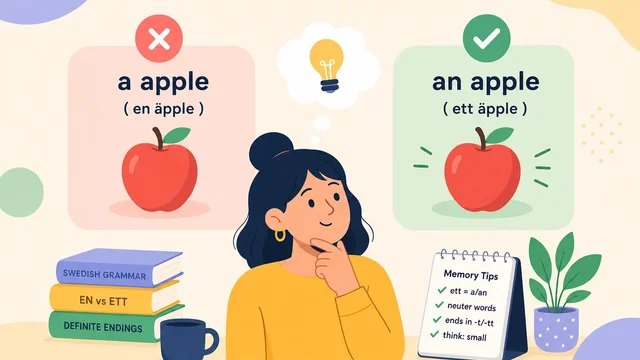
You're writing a Swedish sentence and you reach for the article. You pick ett. You continue: ett röd äpple. It feels close enough, maybe a little off, but surely a minor slip - the kind of thing a native speaker would overlook. One small word at the beginning, right?
Here's the uncomfortable part: that single choice has already broken three other things in the same breath. The adjective is wrong (röd should be rött). The definite suffix you'll reach for a moment later will be wrong too. The demonstrative pronoun that precedes an adjective in a definite noun phrase? Also wrong. The sentence hasn't just wobbled. It has quietly collapsed, and you made one opening choice.
This is the thing most Swedish learners don't realise until it's too late. Grammatical gender in Swedish isn't a label you attach to a noun after you've already formed the sentence. It's the root the whole sentence grows out of. When the root is wrong, everything that grows from it is wrong too. This article walks through exactly how that chain reaction works and, more usefully, what it looks like to fix the problem at the source rather than keep patching the symptoms.
Why Swedish grammar builds everything on a single gender choice
What common and neuter gender actually mean for a sentence
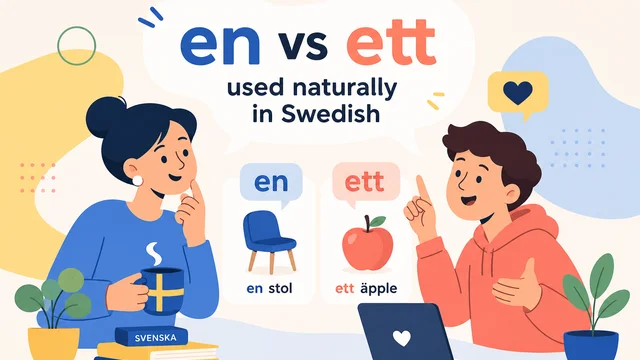
Swedish divides every noun into one of two grammatical genders: common gender (utrum, also called en-words) and neuter (neutrum, also called ett-words). This is not natural gender the way English uses it. English still marks gender for living things - he, she, it - but that's about biology. Swedish grammatical gender is a structural property of the noun itself, and it has almost nothing to do with what the noun refers to. A car (bil) is an en-word. A house (hus) is an ett-word. Neither choice follows from the object in the world.
The article isn't decoration sitting in front of the noun. It's a signal that the rest of the sentence reads and responds to, adjusting its form accordingly. For a technical overview of how these gender distinctions work across the language, see Swedish grammar.
Why English speakers start from behind
Old English had grammatical gender; Modern English no longer uses it productively, which means English speakers arrive at Swedish with no built-in instinct for it. When a learner chooses en or ett, they're usually guessing based on feel, a half-remembered example, or weak association.
The statistics offer a tempting shortcut: roughly 75-80% of Swedish nouns are en-words, so defaulting to en gives you a decent hit rate at beginner level. But that habit trains nothing. It lets you survive simple exchanges while building none of the gender knowledge you'll need the moment sentences get more complex. The errors compound quietly, and the learner never quite understands why their Swedish sounds slightly off even after months of practice.
Why getting en or ett wrong affects the whole Swedish sentence
The adjective ending shifts first
The rule is clean once you see it laid out. In an indefinite noun phrase, en-words take the base adjective form: en röd bil (a red car). Ett-words take the adjective plus -t: ett rött hus (a red house). If a learner writes ett röd hus, the adjective is immediately wrong. The -t is missing. That's error number two, triggered in the same phrase as error number one, with no pause between them.
Then the definite suffix goes wrong too
Later in the same sentence, the learner needs the definite form of the same noun. En-words attach -en or -n: bil becomes bilen. Ett-words attach -et or -t: hus becomes huset. If the learner has the wrong gender stored in their head, they'll reach for the wrong suffix. Huset becomes husen. The definite form of the noun is now broken. That's error number three, and it flows directly from the first wrong choice.
The demonstrative pronoun follows the wrong lead
When a Swedish noun phrase is definite and includes an adjective, a pre-adjective determiner appears: den for en-words, det for ett-words. The wrong gender produces the wrong determiner. Det röda huset (the red house) becomes den röda huset, and now you have four simultaneous mistakes from a single wrong opening choice. For many learners the cascade of errors feels disproportionate to the size of the initial mistake.
A sentence pulled apart: watching the full collapse
Building the correct version first
Take bord (table), which is an ett-word. The indefinite phrase: ett litet bord (a small table). The adjective litet carries the -t because the noun is neuter. The definite phrase: det lilla bordet (the small table). The adjective shifts to lilla in the definite form, the noun takes -et, and the determiner is det. Every piece locks into the others. The sentence feels smooth because the gender is right and all the dependent forms follow naturally.
Swapping the article and counting the damage
Now imagine the learner stores bord as an en-word instead. The indefinite phrase becomes en litet bord. Already wrong: litet should now be liten if it were truly an en-word, so the adjective is broken. Moving to the definite form, the learner reaches for -en instead of -et: borden instead of bordet. And the determiner shifts from det to den. Four errors, one root cause.
Grammatical gender is not a decorative detail. It is load-bearing. Every other form in the noun phrase is hanging off it.
Patterns that help you predict the right gender
Noun endings as probability cues, not guarantees
The most useful patterns to carry with you are these. Nouns ending in -a, -e, -er, and -ing lean strongly toward en. Certain short consonant-final nouns like hus, barn, and fel lean toward ett. Abstract nouns ending in -het (like frihet, freedom) and -ning (like tidning, newspaper) are very often en-words. Frame all of these as cues that raise your probability of a correct guess, not as rules that always hold. They won't. But they're much better than nothing. For a walkthrough of common noun patterns and endings, see this overview of Swedish nouns.
Semantic categories as a second layer
Nouns referring to people and living things lean heavily toward en. This is a useful instinct to build. But then there's ett barn (a child). Every Swedish teacher brings it up on day one. Learn it separately and move on - don't let one exception undermine the general tendency, because the tendency is still worth using.
The conclusion from research into Swedish L2 acquisition is that endings help more than meaning, but neither works on its own for every noun. The only reliable method is to internalise gender at the noun level, so that when you think hus, the ett is already there, not reconstructed from a rule each time you need it.
How training gender instinct fixes the whole sentence at once
Why fixing the root is more efficient than drilling each form separately
A common pattern among Swedish learners: when adjective endings start looking wrong, the instinct is to drill adjective endings. When definite suffixes are off, those get drilled separately. But adjective agreement, definite suffixes, and plurals are all downstream of the same thing. Drilling each form in isolation is like fixing the branches while the root is still wrong. The same errors will come back because nothing has changed at the source.
The more efficient path is to own the gender of each noun at the moment you first learn it, so the rest of the sentence can fall into place without conscious calculation every time.
How Artikulera approaches this problem
This is exactly the problem Artikulera was built to solve. Many general language apps treat en/ett as a footnote, something you absorb gradually through exposure. But exposure alone, without focused repetition, doesn't build instinct - it builds fragile recall that cracks under sentence-level pressure.
Artikulera is built exclusively around this one problem, with a large bank of Swedish nouns, learnable noun-ending rules of thumb, and dedicated practice modes covering the article form, the definite suffix, and the plural ending. Those three modes aren't random: they map directly to the three forms that break when you get the gender wrong.
The app uses a spaced repetition schedule designed to surface each noun before the association fades, with the goal of making noun gender feel instinctive over time rather than something you have to reconstruct mid-sentence. The timed practice modes are designed to move that knowledge from slow, deliberate retrieval toward something faster and more automatic. When gender becomes automatic, the sentence starts to write itself. The adjective ending falls into place. The definite suffix is obvious. The demonstrative is not a choice you make consciously - it's just the right word, already there.
The article was never just a small word
Return for a moment to that learner who thought they made one small mistake. Understanding why getting en or ett wrong affects the whole Swedish sentence isn't meant to be discouraging - it's meant to be useful. The reason Swedish feels hard to produce accurately, even when vocabulary is solid and motivation is high, is often that gender is still being guessed rather than known. Every uncertain en or ett sends a crack through the rest of the sentence, and the cracks multiply faster than most learners realise.
The good news is that this is a fixable problem. It just needs to be fixed at the right level. Learning gender as an inseparable part of each noun - not as a separate quiz layered on top - changes the whole experience of building Swedish sentences. You stop fighting the language on four fronts simultaneously. Instead, one solid piece of knowledge, the gender of the noun, makes four other choices automatic.
Swedish grammatical gender stops feeling like a trap and starts feeling like a framework. The adjective form, the definite suffix, the plural ending, the demonstrative: they were always connected. The article was never a small word sitting in front of a noun. It was the foundation the rest of the sentence was standing on.

Practice Swedish en/ett with Artikulera
Spaced repetition, 30 rules of thumb, and 4,500+ nouns. Free to download.
Free · iPhone & iPad · iOS 17.6+
Frequently asked questions
- Why does choosing en or ett change the rest of a Swedish sentence?
- Grammatical gender in Swedish is a structural property of the noun that the rest of the sentence reads and responds to. A wrong choice immediately forces incorrect adjective endings, definite suffixes, and demonstratives because those forms depend on the noun's gender. The gender choice is the root that everything else grows from.
- How do adjective endings change for en-words and ett-words in indefinite phrases?
- In an indefinite noun phrase, en-words take the base adjective form, as in en röd bil (a red car). Ett-words add -t to the adjective, as in ett rött hus (a red house), so writing ett röd hus makes the adjective wrong immediately.
- What happens to the definite form of a noun if you get the gender wrong?
- En-words form the definite with -en or -n (bil becomes bilen) while ett-words use -et or -t (hus becomes huset). If you have the wrong gender in your head you will attach the wrong suffix, for example producing husen instead of huset, which breaks agreement across the sentence.
- Do en and ett correspond to natural gender like he/she/it in English?
- No. Swedish grammatical gender (utrum and neutrum) is not the same as natural or biological gender. It is a structural feature of the noun itself and often bears no relation to what the noun refers to. Bil is an en-word and hus is an ett-word regardless of their real-world properties.
- Why do English speakers often default to en and why is that a problem?
- Modern English has lost productive grammatical gender, so English speakers lack an instinct for en/ett and often guess based on feel or statistics. Because about 75-80% of Swedish nouns are en-words, learners defaulting to en get many short-term hits but fail to build reliable gender knowledge, which causes compounding agreement errors as sentences become more complex.
- How can I fix en/ett mistakes at the source instead of patching symptoms?
- Learn and practise each noun together with its article and common agreement patterns (adjective forms and definite suffixes), and use spaced repetition to reinforce the pairing. Practise producing full phrases (indefinite and definite) rather than memorising nouns in isolation. When gender becomes automatic, adjective endings and definite suffixes fall into place without conscious calculation.