En vs ett: Why Duolingo falls short on Swedish gender

Photo: Nik Gracner / Scopio
You finished the lesson. Your streak is still alive. You got eight out of ten right. And then someone at work asks what you had for lunch, and you want to say "an apple" in Swedish, and you freeze, because you genuinely cannot remember if it's ett äpple or en äpple.
If you've been comparing an en vs ett app to Duolingo, trying to figure out which one will finally make Swedish gender click, you've probably already noticed the gap. General language apps are optimized for breadth: a little vocabulary, some listening, some grammar, spread across hundreds of topics. Swedish grammatical gender doesn't need breadth. It needs depth, repetition, and a rule-based framework that most platforms treat as a footnote. This article walks through exactly where that gap opens up, what it takes to close it, and why a focused en vs ett app outperforms Duolingo for this specific problem.
I'll also cover Artikulera, an app built exclusively around this one problem, because it's directly relevant. But first, let's understand why en and ett are genuinely difficult, not just annoying.
Why Swedish noun gender trips up even dedicated learners
About 75% of Swedish nouns are en-words and about 25% are ett-words. That ratio sounds like good news, and in a way it is: if you guess "en" for every noun you don't know, you'll be right three quarters of the time. But that statistic creates a subtle trap. Early practice feels manageable. Most beginner-lesson nouns are en-words. Your confidence builds. Then the vocabulary expands, ett-words start accumulating, and suddenly you're making consistent errors on some of the most common everyday words in the language.
The 75/25 split and why it creates a false sense of progress
The problem with the en-majority isn't that it misleads you intentionally. It delays the moment when you realize you need a real system. You get enough right answers on beginner exercises to feel like the concept is handled. But ett-words are not rare edge cases. They include ett hus (house), ett barn (child), ett bord (table), ett år (year), and ett arbete (work). These are core vocabulary. Missing them consistently doesn't just sound slightly off, it changes the definite form, the pronoun reference, and the plural ending all at once.
What the definite form tells you that the indefinite form hides
One of the most useful practical tests gets skipped in a lot of general courses. If you see a noun in its definite singular form ending in -en or just -n, that's an en-word. If it ends in -et or -t, it's an ett-word. So bordet tells you it's ett bord, and skolan tells you it's en skola. This isn't perfect, but it's a fast mental shortcut that experienced readers use constantly, often without thinking about it. Getting comfortable with this test early saves a lot of learners a lot of guessing.
Why exceptions matter more than most courses admit
Here's the honest part: patterns have exceptions. Knowing that nouns ending in -are are almost always en-words is genuinely useful, but "almost always" is doing real work in that sentence. A good learning framework gives you the rule clearly, marks the exceptions explicitly, and then gives you enough targeted repetition with both that you stop freezing in real use. That combination is exactly what general platforms aren't structured to provide.
En vs ett on Duolingo: what it teaches and what it skips
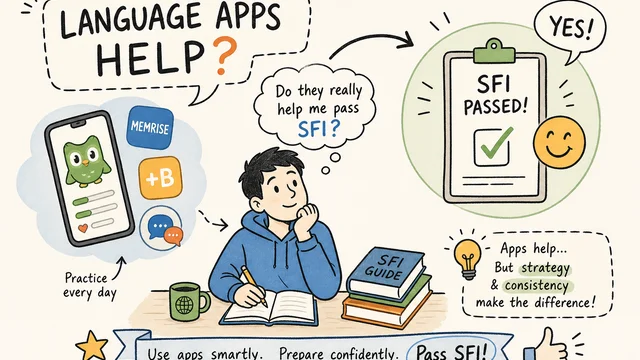
Let me be fair here. Duolingo does teach en and ett. The Swedish course introduces both noun classes, explains the definite suffix system, and uses spaced repetition to resurface vocabulary. It also does something genuinely valuable: it builds a daily habit. For many learners, Duolingo is the reason they're still studying Swedish six months in. Consistency compounds, and an imperfect daily practice beats a perfect plan you abandon after two weeks.
How Duolingo introduces en and ett (and what the hints skip)
The typical Duolingo format for article practice involves translation prompts, word-bank selections, and short grammar hints. The explanations are brief by design, the app's philosophy is to let learners infer patterns from repeated exposure rather than front-load explicit rules. For many grammar points, that inference approach works well enough. For Swedish grammatical gender specifically, it tends to produce learners who recognize the right answer when they see it on a familiar exercise screen but still hesitate when constructing a sentence from scratch. The hints rarely explain suffix patterns, why a particular noun is classified the way it is, or how to reason about a noun you've never encountered before.
The gap between exercise recall and real production
This is the core problem, and it's worth sitting with for a moment. Passing a Duolingo exercise requires pattern-matching within a controlled, predictable format. You see the noun, you see the answer options, you select the right one. That's a recognition task. Producing the correct article mid-sentence in real conversation is a completely different skill, it requires automaticity, the kind of recall that happens faster than conscious thought. Duolingo's exercise format trains the first skill well and the second skill barely at all. That's not a criticism of Duolingo's engineering; it's a structural consequence of what the platform is trying to do across an entire language curriculum.
The suffix patterns a general app won't go deep on
If you want a working toolkit for unfamiliar nouns, suffix patterns are where to start. A specialized en vs ett app builds these into its core. A general platform mentions them in a grammar note you scroll past. Here are the patterns that cover the largest share of real-world vocabulary. For a concise breakdown of these noun gender patterns that illustrates many of the same suffix rules, see the noun gender in Swedish: en words vs ett words guide.
En-word endings that cover the vast majority of cases
Several noun endings are strong predictors of en-words. Nouns ending in -a are very reliably en-words: en skola, en flicka, en väska. Nouns ending in -ning or -ing follow the same pattern: en tidning, en lösning. The suffix -het is one of the most reliable signals in the language: en nyhet, en frihet. Agent nouns ending in -are are almost universally en-words: en lärare, en läkare. And if a noun forms its plural with -or, -ar, or -er, it's almost certainly an en-word.
Ett-word signals worth targeting first
Because ett-words are fewer, the most efficient strategy is to learn to recognize them specifically and treat en as the default fallback. The clearest ett-word signal is a consonant-ending noun whose plural form is identical to the singular: ett bord, bord; ett barn, barn; ett ägg, ägg. Vowel-ending nouns that add -n to form the plural are also typically ett-words: ett äpple, äpplen; ett kvitto, kvitton. Memorizing ett-words as a targeted set is faster and more efficient than trying to hold the entire gender system in your head as one undifferentiated mass. For more on common neuter signals and exceptions, see this overview of common neuter gender patterns.
Depth vs. breadth: what a focused en vs ett app does differently than Duolingo
A general language platform is designed to move learners through vocabulary, listening, reading, and speaking across hundreds of topics. That's genuinely useful for building a broad foundation. But depth on a single grammar point competes directly with breadth across a full curriculum. Every lesson that teaches colors, directions, and food vocabulary is a lesson that doesn't drill en and ett specifically. There's nothing wrong with that trade-off for the platform's overall purpose. The problem is when a learner whose main obstacle is grammatical gender keeps reaching for a breadth tool when what they need is a depth tool.
Why breadth works against mastering a single hard grammar point
When en and ett practice is distributed across hundreds of vocabulary topics, the signal-to-noise ratio is too low for the brain to build a reliable instinct. You get some article exposure in every lesson, but never enough concentrated repetition to move from "I know this one" to "I know how to figure out any noun I haven't seen before." The pattern recognition that experienced Swedish speakers use automatically only develops through the kind of focused, repeated retrieval that a general curriculum simply isn't designed to provide.
How spaced repetition changes the outcome when it's focused
Spaced repetition works by timing reviews for just before you're about to forget something, making the memory trace significantly more durable than if you'd reviewed earlier or later. When that system is applied to a broad vocabulary course, the spacing effect still works, but it's applied to everything at once. When spaced repetition is focused exclusively on en and ett, every session compounds directly on the specific skill you're trying to build. The difference in outcome isn't marginal. It's the difference between slow general improvement and measurable targeted progress on exactly the problem you're trying to solve. The underlying research on why spaced repetition is effective is well summarized in analyses of the science behind spaced repetition and explains why focused scheduling produces faster automaticity.
How Artikulera fills the gap Duolingo leaves
Artikulera is the only app built exclusively around the en and ett problem. It was developed in collaboration with SFI teachers (Swedish for Immigrants), grounding it in real classroom experience with the exact mistakes non-native learners make consistently. The goal isn't just to help you memorize the article for a list of nouns. It's to build the kind of internalized system that lets you make a confident educated guess on a word you've never seen before. For a practical, strategic companion read on mastering these articles in Swedish, consider this strategic guide to mastering en and ett in Swedish.
Rule-based learning combined with 4,500+ nouns
The app contains 30 rules of thumb covering the vast majority of Swedish nouns, each with a mastery ring that tracks how well you've internalized that specific rule, not just how many nouns you've practiced. This is the explicit rule-based layer that Duolingo's brief grammar hints can't replicate. You're not just building a list of memorized noun-article pairs. You're building a functional system that transfers to new vocabulary.
From memorized to instinctive with timed practice
Artikulera uses a timed 5-star mastery system and a Time Challenge mode specifically designed to push learners past the point of "I know this if I think about it." Slow recall is not fluency. The timed format creates pressure that forces recall to become automatic rather than deliberate, and that shift from conscious retrieval to instinctive production is exactly what gets skipped in exercise formats where you have unlimited time to select from a word bank.
Built for learners who have already hit the Duolingo ceiling
If you've been using a general language app and built a real daily habit, that's genuinely valuable and worth keeping. But if you're still hesitating on articles after months of consistent practice, the habit is working and the tool needs supplementing. Artikulera is free to download, developed with professional SFI teachers, and focused entirely on the specific pain point that breadth-first platforms leave unresolved. It's not a replacement for general language practice. It's the targeted depth layer that general practice can't provide on its own.
A practical plan to stop guessing and start knowing
Here's what the reasoning above actually points to as a concrete path forward, starting right where you froze on that apple.
Start with ett-words and treat en as the default
Because ett-words are the minority, the most efficient strategy is to build a solid mental list of them first and let en be your confident fallback for everything else. Start with the highest-frequency everyday nouns and drill them until they're automatic:
- ett barn (child)
- ett hus (house)
- ett bord (table)
- ett äpple (apple)
- ett brev (letter)
- ett ord (word)
- ett år (year)
- ett land (country)
- ett sätt (way/manner)
- ett arbete (work)
These ten nouns alone will cover an enormous amount of everyday communication. Once they're automatic, expand the list. The point is to build a reliable mental exception list so that when you encounter a noun and nothing on your ett-list fires, "en" becomes your confident default rather than a coin flip.
Combine suffix rules with daily targeted practice
Use the suffix patterns as a first-pass filter when you encounter unfamiliar nouns: check for -a, -ning, -het, -are as en-signals, and check for identical plural forms as your primary ett-signal. Then reinforce with a focused spaced-repetition tool so the patterns move from rules you consult to instincts you deploy. Pairing rule-based learning with active reading in Swedish accelerates this process: seeing the patterns in real sentences makes them stick faster than flashcard practice alone.
The right tool for the right stage
Duolingo built something genuinely useful in habit formation and broad exposure. For many learners, a general app is the right starting point, and the foundation it builds is real. But there's a moment in every language learner's journey where breadth stops serving them and depth becomes the only path forward. Swedish grammatical gender is exactly that inflection point for most learners of the language.
The en and ett system is not impossibly hard. It has real patterns, reliable suffix signals, and a tractable number of exceptions. What it requires is focused practice aimed specifically at building the kind of automatic recall that surfaces in real conversation, not just in controlled exercises. That's a different kind of tool from the one most learners are using, and understanding that difference matters more than any individual vocabulary tip.
When you're comparing an en vs ett app to Duolingo and wondering which one will get you past the freeze, the answer depends on where you are in your journey. If you have the habit and the motivation but keep hesitating on articles, a general platform can't give you what you need next, Artikulera can. Download it free and see what focused practice on this one specific problem actually feels like.

Practice Swedish en/ett with Artikulera
Spaced repetition, 30 rules of thumb, and 4,500+ nouns. Free to download.
Free · iPhone & iPad · iOS 17.6+
Frequently asked questions
- Why is Swedish gender (en vs ett) harder than it looks?
- About 75% of Swedish nouns are en-words and 25% are ett-words, so guessing en often works at first and creates a false sense of mastery. As vocabulary grows, ett-words-including common nouns-start causing repeated errors that affect definite forms, pronoun reference, and plurals. The article argues this gap requires a rule-based framework and targeted repetition that many general apps don’t provide.
- How can I quickly tell if a Swedish noun is en or ett?
- A practical test is to look at the definite singular form: nouns ending in -en or -n are en-words, while those ending in -et or -t are ett-words. This shortcut isn’t perfect but is a fast mental check native readers use and that the article recommends teaching early. Knowing this saves guessing in real conversation and reading.
- Does Duolingo teach en and ett effectively?
- Duolingo does introduce en and ett, explains the definite suffix system, and uses spaced repetition to resurface vocabulary while building a daily habit. However, the article says Duolingo often lacks the depth, explicit rule+exception lists, and targeted repetition needed to stop learners freezing on gender in real use. In short, it’s good for consistency but limited for mastering gender.
- What do focused en vs ett apps do differently from Duolingo?
- Focused apps prioritize depth: they present clear rules, mark exceptions explicitly, and provide high-frequency, targeted practice on the definite endings and troublesome words. The article points to this combination-rule-based instruction plus repetition-as why a single-problem app outperforms broader platforms for gender. It also highlights Artikulera as an app built exclusively around this problem.
- Which common Swedish words are ett-words I should memorize first?
- The article lists core ett-words that learners often miss, including ett hus, ett barn, ett bord, ett år, and ett arbete. These are frequent nouns whose gender affects definite forms and pronoun choices, so memorizing them early reduces noticeable errors. Targeted drills on these words are more useful than broad vocabulary lists.
- Are there useful patterns or endings that predict en vs ett?
- Yes-patterns like nouns ending in -are being almost always en-words are helpful, but the article warns that patterns have important exceptions. A good learning framework states the rule, flags exceptions, and gives repetition with both so learners stop hesitating. Relying solely on broad exposure without explicit exception practice is what causes persistent mistakes.
- How should I practice en/ett outside of Duolingo to get better fast?
- Use the definite-form test (look for -en/-n vs -et/-t endings) in reading, create targeted spaced-repetition drills for common ett-words, and study clear rule+exception lists. The article recommends focused apps like Artikulera or short, repetitive exercises that force you to apply the rule under realistic conditions rather than only learning mixed vocabulary. Consistent, deliberate practice beats passive exposure for this problem.