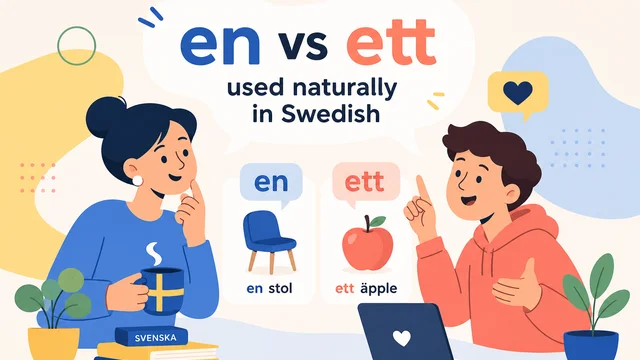
How to quickly learn Swedish noun genders
Most learners make this harder than it needs to be. Here's the systematic approach - rules first, then spaced repetition, then context - that actually works.

Step 1: Accept that gender matters (a lot)
Many Swedish learners try to skip en/ett and learn nouns without their gender. This is the single biggest mistake. Gender in Swedish is not decoration - it determines:
- The definite form: hunden (the dog) vs bordet (the table)
- The pronouns you use: den (it/common) vs det (it/neuter)
- Adjective agreement: en stor hund vs ett stort bord
- Plural suffixes and definite plural forms
Get gender wrong and every downstream piece of grammar sounds off. Fix it early.
Step 2: Learn the 30 rules of thumb first
Before memorizing individual nouns, invest a week in the 30 rules of thumb. These patterns let you predict the gender of a noun you've never seen before with reasonable accuracy:
- Suffix rules (26): if a noun ends in -het, -ing, -are, -tion, -sion, -ism, -ist, or -ik, it's almost certainly en. Ends in -um or -ment? Almost certainly ett.
- Semantic rules (4): animals, people, drinks, and plants are almost always en.
- Default: when no rule applies, guess en - you'll be right ~75% of the time.
Once you know the rules, you can make educated guesses for new vocabulary instead of looking everything up. See all 31 rules →
Step 3: Use spaced repetition for the exceptions
The rules cover most nouns, but exceptions exist. Ett lejon (a lion) breaks the animal rule. Ett program breaks intuition for tech learners used to English. These must be memorized individually.
Spaced repetition is the most efficient way to do this. The algorithm schedules each word for review just before you'd forget it, then increases the gap each time you get it right. The result: you spend almost no time on words you know well, and lots of time on the ones you keep getting wrong.
Artikulera is built specifically for this: it tracks your five-star mastery for each noun and shows you the applicable rule on incorrect answers, so every mistake is a learning moment.
Step 4: Always learn the noun with its article
Never write "hund" in your vocabulary notebook. Always write "en hund". Always say it aloud with the article. The gender should be inseparable from the word in your memory - not a separate lookup you do afterward.
This is the same advice given for German learners (always learn der/die/das with the noun) and it applies equally to Swedish.
Step 5: Reinforce through reading and listening
Flashcards build the scaffolding; real input fills it in. Once you've learned the basics, start reading Swedish content - news, books, subtitles - and actively notice article usage. Your brain will pick up on patterns that no rule can fully articulate.
Good resources for immersive input:
- SVT Play - Swedish public TV with subtitles
- SR (Swedish Radio) - podcasts and news in easy Swedish (Lätt svenska)
- 8 Sidor - simplified Swedish news written for language learners
- Riksteatern / Swedish subtitled films - film with Swedish subtitles
Step 6: Track your progress
Motivation drops when progress is invisible. Use tools that show you concretely how many words you've mastered and which rules you've internalized. Artikulera shows a radial mastery tracker for each of the 30 rules - seeing the ring fill up is genuinely satisfying and keeps you coming back.
Aim for 10–15 minutes per day rather than hour-long marathon sessions. Consistency beats intensity for spaced repetition to work correctly.

Practice Swedish en/ett with Artikulera
Spaced repetition, 30 rules of thumb, and 4,500+ nouns. Free to download.
Free · iPhone & iPad · iOS 17.6+
Frequently asked questions
- How long does it take to learn Swedish noun genders?
- Most consistent learners can predict the gender of common nouns reliably within 3–6 months of daily practice. The first month focuses on learning the 30 rules of thumb; months 2–6 build fluency through spaced repetition and real reading/listening. Full intuition - where en/ett feels automatic - typically comes after 1–2 years of immersive use.
- Should I learn en/ett from the start?
- Yes. Learning nouns without their gender is the most common Swedish learner mistake. The gender affects the definite form, plural endings, adjective agreement, and pronoun choice. Fix it early and all downstream grammar becomes easier. It's much harder to re-learn a noun's gender later than to learn it correctly the first time.
- What is spaced repetition and why does it work for en/ett?
- Spaced repetition is a scheduling algorithm that shows you a flashcard just before you're about to forget it, then increases the interval each time you answer correctly. Research shows this is the most efficient way to move information into long-term memory. For Swedish gender, spaced repetition means you spend most of your time on the words you keep forgetting - not the ones you already know well.
- Is it better to learn en/ett in context or with flashcards?
- Both, in sequence. Learn the 30 rules of thumb first so you can make educated guesses for unfamiliar words. Then use spaced repetition flashcards for the exceptions and high-frequency nouns. Finally, reinforce everything through reading and listening - context cements what flashcards introduce.