Spaced repetition for language learning that actually sticks
The forgetting curve, how SRS algorithms schedule reviews, and the flashcard design rules that turn short-term recall into long-term memory.
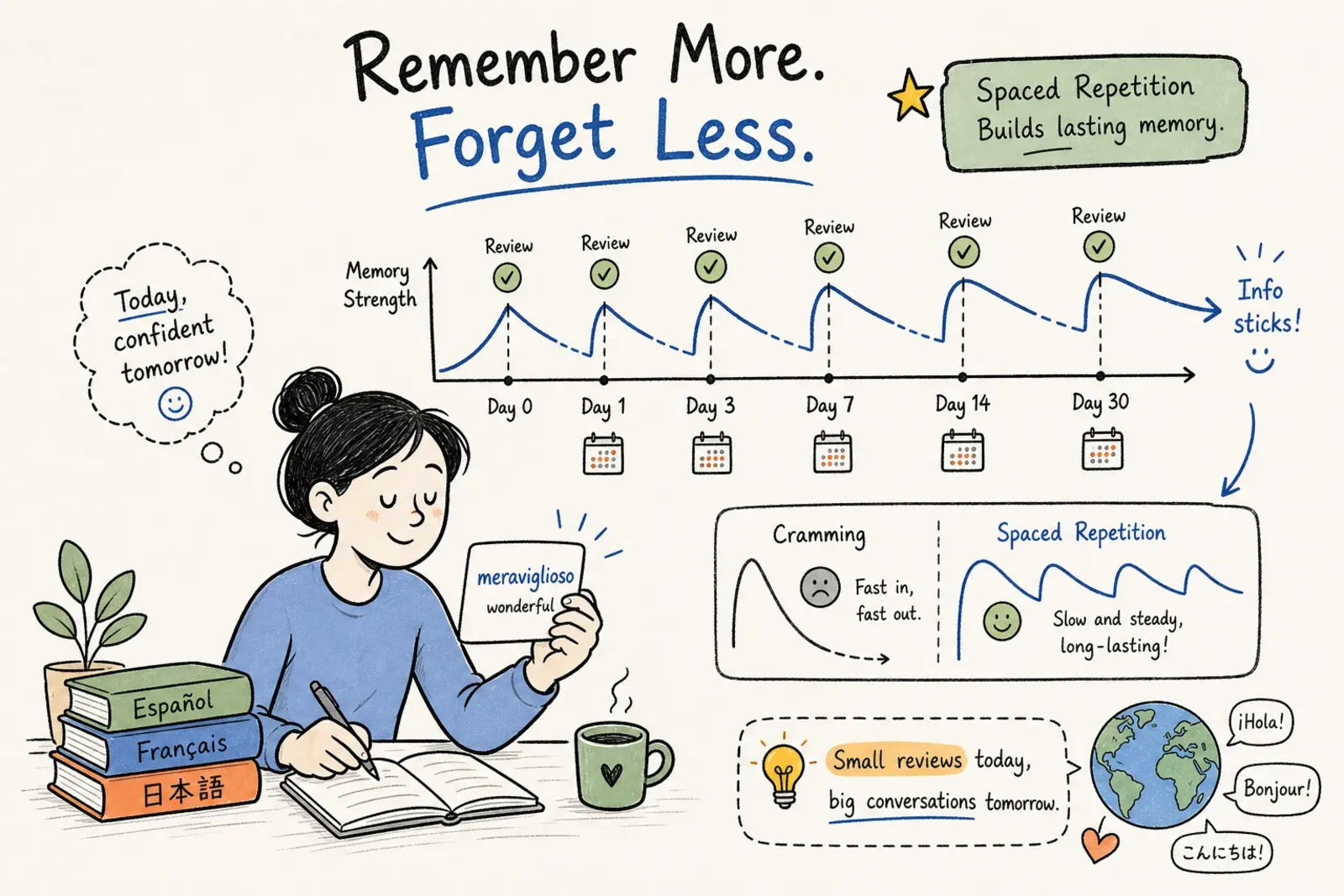
You spent an hour drilling vocabulary. You felt solid. Then, three days later, the words were gone. Not blurry - just gone. That's not a memory problem. It's a method problem, and it has been documented since 1885, when the German psychologist Hermann Ebbinghaus mapped exactly how fast the brain discards new information when you don't review it at the right time. Spaced repetition addresses this directly, by scheduling reviews for the moment your memory of a word is about to fade.
Working on Artikulera, an app built around spaced repetition for Swedish grammatical gender, makes the mechanics of memory-based learning impossible to ignore. When your product depends on users actually retaining what they practice, you read every study that touches on it. What the research shows is consistent, replicable, and mostly ignored by casual learners.
This article covers the forgetting curve, how spaced repetition algorithms calculate review intervals, how to build flashcards that actually support recall, what the research says about review schedules, and how to pick a tool that fits your goals.
Why your vocabulary keeps disappearing
Ebbinghaus ran memory experiments on himself in 1885 and mapped what's now called the forgetting curve. After first learning something, retention drops steeply in the first 24 hours, then levels off. The numbers are sobering: roughly 44% of new information remains after one hour, about 33% after 24 hours, and only around 25% after one week. This isn't a quirk of his methods - modern studies replicate the same basic shape.
The practical implication is direct: a vocabulary list studied on Monday is mostly gone by Wednesday. Not because you're a poor learner, but because you reviewed it once, at full intensity, and then stopped. That pattern is called massed practice, and it produces a specific illusion - strong short-term recall that feels like learning but collapses on any delayed test.
The research on this is concrete. A study published in CALICO Journal found that learners using spaced vocabulary practice retained words at roughly three times the rate of a control group, with fully learned items at 50.1% versus 16.9%. The Bloom and Shuell French vocabulary study from 1981 showed the same pattern: immediate scores were similar between spaced and massed groups, but a four-day retention test clearly favored the spaced group. The gap in outcomes isn't subtle.
What changes with spaced repetition is the trajectory of the forgetting curve itself. Each successful retrieval resets the curve, but shallower than before - the word decays more slowly after each review. Repeat the cycle enough times, and the interval between reviews can stretch to weeks, then months, without meaningful loss. That's the mechanism the whole system exploits.
How spaced repetition algorithms schedule your reviews
The Leitner system: the original spaced repetition
The conceptual ancestor of every digital SRS is the Leitner system, developed by the German science journalist Sebastian Leitner in the 1970s. The original version was purely physical: a set of index-card boxes numbered by review frequency. New cards started in Box 1, reviewed daily. Answer correctly, and the card moved forward to Box 2, reviewed every three days. Answer wrong, and it moved back to Box 1. The further forward a card sat, the longer its review interval - simple, adaptive, and effective without any software at all.
SM-2: the algorithm behind most apps
Digital spaced repetition systems replaced the boxes with an algorithm. The most influential is SM-2, originally developed for SuperMemo. When you rate your recall on a scale of 0 to 5, SM-2 calculates the next review date from your response and the card's current ease factor. For successful recalls (rated 3 or higher), the first two intervals are fixed at 1 day and 6 days. After that, the next interval equals the previous interval multiplied by the ease factor, rounded up to a whole day.
A correct, confident recall increases the ease factor slightly. A hesitant or failed recall decreases it and resets the interval to 1 day. The system personalizes to your actual memory performance rather than following a generic calendar - that adaptability is what separates a true SRS from any fixed study schedule you could build yourself. For a readable walk-through of the mechanics, see this explanation of how SM-2 schedules reviews.
What "optimal spacing" means in practice is more nuanced than any single fixed sequence. The research doesn't support one schedule - like 1-3-7-30 days - as universally best. The ideal interval depends on how long you need to retain the word. For vocabulary you need within a week, short gaps of 1 to 3 days work well. For long-term retention over months, the early intervals should still be short, but later intervals need to stretch progressively. The core principle holds across studies: adaptive scheduling based on recall performance beats any fixed calendar.
Writing flashcards that work with your memory
The most common flashcard mistake is cramming too much onto a single card. A card that tests word meaning, grammatical usage, pronunciation, and a grammar note all at once creates ambiguity during recall - when you retrieve the answer, the algorithm can't tell which piece you actually remembered and which you guessed. The rule is one card, one retrieval task. Keeping cards atomic is what lets the algorithm accurately track your memory of each individual item.
Context is the most important variable
An isolated word on the front with a bare translation on the back is the weakest possible format. A short example sentence showing the word in real use is significantly more effective. Native-speaker audio connects spelling to pronunciation and activates listening recognition alongside reading. Images work well for concrete nouns, partly because they short-circuit translation entirely and build a direct mental link. None of this is decorative - it's the memory hooks that spaced repetition then reinforces at each review.
The direction of the prompt matters more than most learners realize, too. For reading and listening comprehension, put the target-language word on the front and the translation on the back - that's recognition practice, and it's what most flashcard decks provide. For speaking and writing, you need reverse cards as well: native-language prompt on the front, target-language production on the back. Learners who only do recognition practice often wonder why their active output stays weak. The answer is that they've never tested themselves in that direction.
For practical comparisons of flashcard approaches for Swedish specifically, and when to use Anki versus paper or apps, see Best Flashcard Method for Swedish: Anki, Apps, Paper.
What the research says about review schedules
The forgetting curve is steepest immediately after first learning. Waiting a full week before the first review means significant loss has already happened - the first review on a new word should come within 24 hours. After a successful recall, the interval can safely expand. Research supports an optimal first-review gap of roughly 20 to 40% of the target retention window. For a word you need within a week, that puts the first review at 1 to 3 days.
For long-term retention, longer spacing clearly outperforms shorter spacing on delayed tests. A 7-day spaced condition produced better delayed recall than a 1-day condition in multiple studies, and the Goossens et al. study found that spaced learners recalled significantly more words after a one-week delay than massed learners - a gap comparable to the CALICO Journal retention figures above. For a broader review of the evidence behind spaced practice, see this academic review of spacing effects in learning.
A practical starting progression - review on day 1, day 3, day 7, day 14, and day 30 - aligns with the general principle of expanding intervals and holds up well in practice. Beyond that point, let the algorithm take over. Manual scheduling is error-prone and ignores how difficult individual words are for you specifically; a proper SRS app handles interval calculation better than any spreadsheet you'd build yourself. For more on turning this into a daily routine, see Practice Swedish in 10 Minutes: A Minute-by-Minute Plan and this practical guide to how spaced repetition scheduling helps vocabulary retention.
Picking an SRS tool that matches how you learn
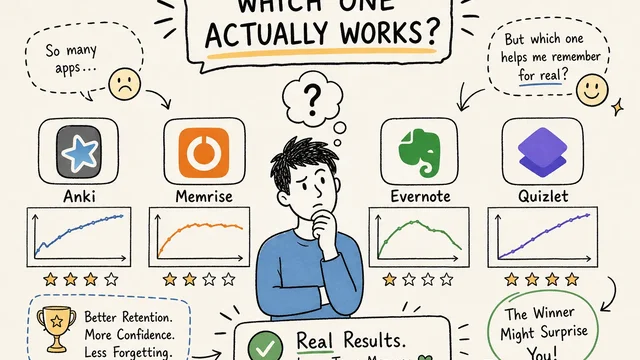
Anki is a strong choice for serious custom decks. It uses a modified SM-2 algorithm and, in recent versions, supports FSRS - a machine-learning scheduler that can reduce review load by roughly 20 to 30% at the same retention rate. It supports audio and multimedia cards, syncs across platforms, and is free on most platforms (the iOS version is a paid one-time purchase). The trade-off is setup time: building a quality deck takes effort, and the interface hasn't changed much since the mid-2000s.
Memrise and Quizlet are easier to start with and more polished on mobile, but both use proprietary scheduling algorithms that aren't publicly documented, which makes it hard to evaluate how well they optimize long-term retention. For casual review or test prep, either is fine. For committed vocabulary work measured in months, Anki's algorithm depth is the more reliable foundation. For a broader comparison of Swedish learning apps, see Best Swedish Learning Apps of 2026: Ranked and Reviewed.
General flashcard tools handle vocabulary well, but they struggle with grammar patterns that require structural intuition rather than simple word recall. Swedish en/ett gender is a clear example: a learner doesn't just need to remember that "bil" is an en-word, they need to produce the correct article mid-sentence, at normal speaking speed, without pausing to think. That requires timed, high-repetition retrieval practice - not spaced flashcards alone.
This is where a focused tool changes the outcome. Artikulera is built around the exact algorithm described in this article, applied exclusively to Swedish grammatical gender. It covers 4,500+ nouns, uses spaced repetition that surfaces each word right before the forgetting curve drops, and includes a timed 5-star mastery system that pushes recall from slow memorization to automatic instinct. For learners who already use Anki for general vocabulary but still hesitate on en/ett, Artikulera handles the one problem general SRS apps leave unsolved - and it's free to download.
The system is simple - the follow-through is what matters
Spaced repetition works because it aligns review timing with how memory actually decays and rebuilds. The forgetting curve isn't a life sentence - it's a map. Use it, and retention compounds over time. Ignore it, and you'll keep re-learning the same words every few months without ever feeling like they stick.
The mechanics aren't complicated. Build focused cards with context and audio. Follow an expanding review schedule and let the algorithm adjust to your performance. Keep cards atomic, review on the day the algorithm schedules, and add reverse cards if active production is your goal. Fifteen minutes of well-timed review beats two hours of cramming on every delayed-retention test in the literature.
For general vocabulary, Anki delivers strong algorithm depth and flexibility. For grammar problems with real structural complexity, a purpose-built tool is worth the focused investment. Memory is trainable - the method just has to match the science. For more on building this into a habit you actually keep, see this summary of evidence-based spaced practice.

Practice Swedish en/ett with Artikulera
Spaced repetition, 30 rules of thumb, and 4,500+ nouns. Free to download.
Free · iPhone & iPad · iOS 17.6+
Frequently asked questions
- Why do I forget vocabulary just a few days after studying it?
- This follows the forgetting curve mapped by Hermann Ebbinghaus: retention drops steeply in the first 24 hours and then levels off. Studying a word once (massed practice) produces strong short-term recall that mostly evaporates on a delayed test, so words that felt solid in the session are often gone within a few days.
- What is massed practice, and why doesn't it work for language learning?
- Massed practice means studying a set of words intensively once and then stopping. It creates an illusion of learning - immediate scores look similar to spaced practice - but on delayed tests it performs far worse. A study published in CALICO Journal found spaced practice produced fully-learned retention of 50.1% versus 16.9% for a massed control group.
- What evidence shows spaced repetition actually improves vocabulary retention?
- Beyond the CALICO Journal study above, the Bloom and Shuell French vocabulary study from 1981 found similar immediate scores for spaced and massed groups but much better four-day retention for the spaced group. The pattern - similar short-term results, large long-term gaps - shows up consistently across the literature.
- How does spaced repetition change the forgetting curve itself?
- Each successful retrieval resets the forgetting curve to a shallower slope, so the word decays more slowly after each review. Repeating this enough times lets review intervals stretch from days to weeks and then months without meaningful loss of retention.
- What is the Leitner system, and how does it relate to modern SRS apps?
- The Leitner system, developed by Sebastian Leitner in the 1970s, used numbered boxes to space paper flashcard reviews: correct cards moved to boxes with longer intervals, incorrect cards moved back. Digital spaced repetition systems are the algorithmic descendants of that idea - they automate the interval adjustments instead of moving physical cards.
- What is SM-2, and how does it schedule review intervals?
- SM-2, developed for SuperMemo, asks you to rate your recall from 0 to 5 and uses that rating plus a card-specific ease factor to set the next review date. For successful recalls (3 or higher), the first two intervals are fixed at 1 day and 6 days; after that, each interval is the previous one multiplied by the ease factor.
- How should I choose a spaced repetition tool for language learning?
- Match the tool to your actual problem. Anki offers the most algorithm depth and flexibility for general vocabulary but requires setup time. For a specific, structural problem like Swedish en/ett gender, a domain-specific app such as Artikulera - built around spaced repetition tied to the forgetting curve, with 4,500+ nouns and 30 rules of thumb - will get you to instinctive recall faster than a general flashcard deck.