Which spaced repetition app actually works?
Anki, RemNote, Brainscape, Quizlet - and when a domain-specific tool beats them all. A practical comparison for 2026.
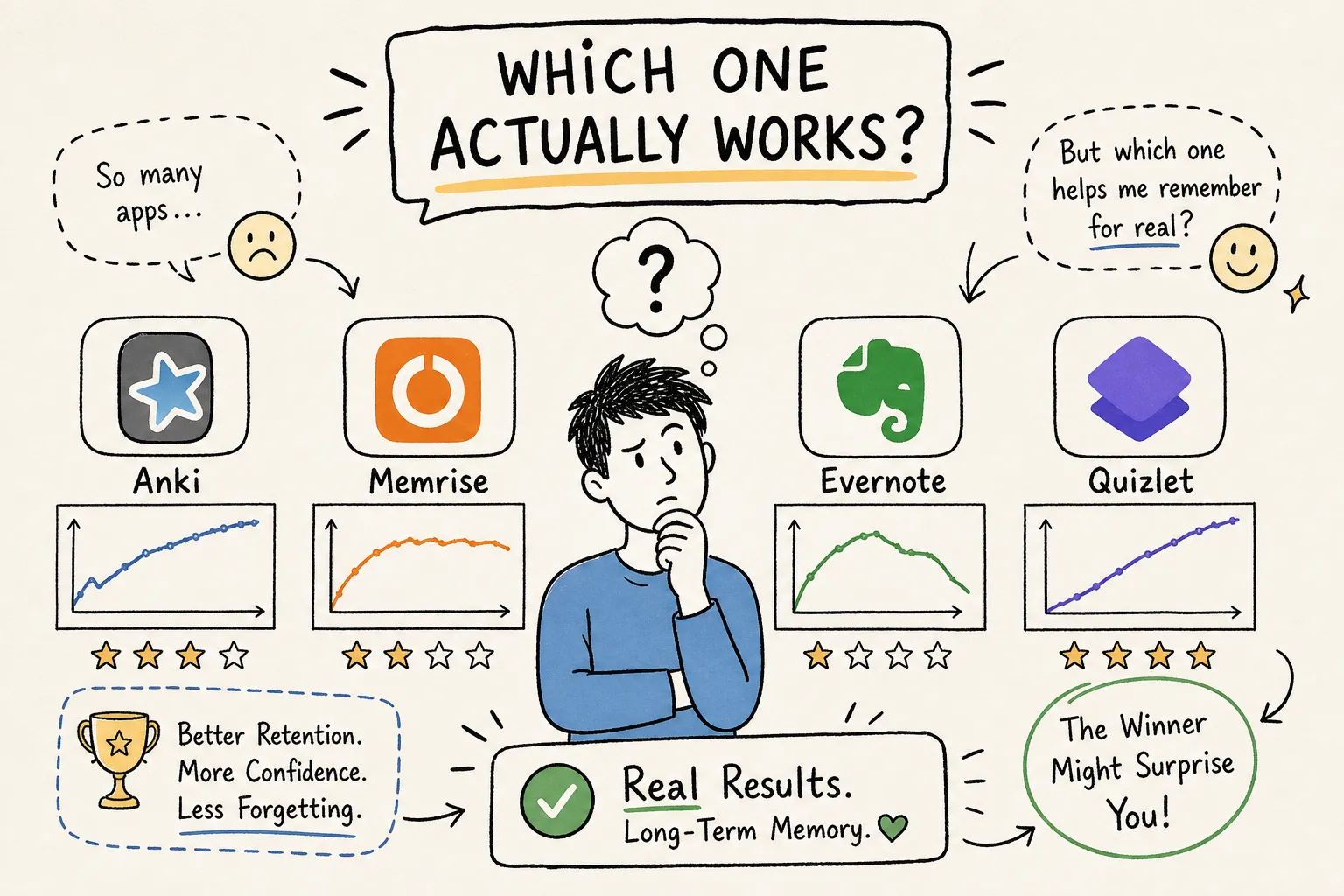
Anki tops most SRS recommendations, and most people searching for a spaced repetition app review download it first. That's a reasonable starting point. Within a week or two, though, many quietly close it and go back to highlighting their textbook. The app isn't broken. The match is wrong.
The best spaced repetition app is not the most powerful one. It's the one built closest to your actual problem. In 2026, there are more options than ever: Anki, RemNote, Brainscape, Quizlet, and a growing category of domain-specific tools. But the fundamental question hasn't changed: does it actually help you remember things long-term, or does it just feel productive?
This spaced repetition app review evaluates the top tools on algorithm quality, real-world retention, and daily usability. By the end, you'll know which one fits your situation and what to do with it.
What separates a good SRS app from one that just looks impressive
The algorithm question: SM-2 vs. FSRS and why it matters
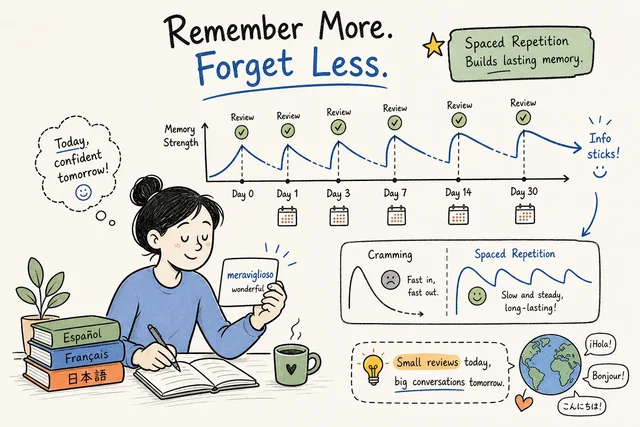
Anki's newer versions now default to FSRS instead of SM-2, and the difference is meaningful if you're doing heavy review volume. SM-2 schedules cards using fixed intervals based on how you rate yourself after each review. FSRS is adaptive: it's trained on large review datasets and schedules cards based on predicted forgetting probability. Open-spaced-repetition benchmark analyses suggest FSRS reduces review load by roughly 20 to 30 percent at similar retention targets compared to SM-2 - real time saved for anyone doing serious daily volume. Note that these figures come from log-based benchmark simulations, not randomized learning trials, so treat them as directional rather than definitive.
For someone doing a handful of cards a day, the gap between the two algorithms narrows considerably. The algorithm matters, but it matters less than whether you actually open the app. Don't let the technical comparison distract you from that basic truth.
The generalist trap most SRS apps fall into
Apps that try to teach everything tend to teach nothing deeply. General-purpose SRS tools optimize for flexibility, which works well for users willing to build their own systems from scratch. That's not great for someone trying to solve one specific, stubborn learning problem. When the gap between the tool and the problem is too wide, learners fill it with setup time instead of study time - and then wonder why the habit never forms.
Anki in 2026
What FSRS changed and what Anki still does better than anyone
The FSRS upgrade made Anki smarter. Scheduling is more accurate, redundant reviews are fewer, and your time per card is better spent. Add a massive community deck library, image occlusion, cloze deletion, and an open plugin architecture, and Anki remains the most capable spaced repetition software available. For medical students and serious language learners, it's the strongest option on raw capability - a conclusion consistently supported by medical education communities and serious language-learning forums alike.
The $24.99 one-time iOS fee is an outlier in a subscription-heavy world. For dedicated learners who know they'll use it consistently, it's worth the investment. For casual users who aren't sure yet, it's a real barrier, and there's no free trial before purchase to reduce that friction.
Who should and shouldn't use Anki
Anki rewards people willing to invest time in setup. If you'll spend 30 minutes building a card format before studying a single word, Anki is your tool. If you want to open an app and start learning immediately, Anki will frustrate you in ways that have nothing to do with the algorithm.
The UX hasn't fundamentally changed in years. It's functional, capable, and dated. That's a deliberate trade-off: Anki bets on power over polish. The consequence is that daily adherence suffers for learners who need low friction. That's not a flaw in the app; it's a mismatch between the tool and the user, and recognizing it early saves a lot of wasted time.
RemNote, Brainscape, and Quizlet: the middle-ground options
RemNote for learners who think in notes
RemNote's core value is tight integration between note-taking and flashcard creation. You write a concept once, convert it to a flashcard inline, and the FSRS scheduler handles the review logic automatically. At $8/month for Pro, it's the strongest option for students who already live in a note-taking workflow and want SRS embedded rather than bolted on as a separate habit.
The learning curve is lower than Anki, though higher than most mobile apps - a trade-off that user reviews consistently flag. The main complaint is a familiar one: the feature set is broad enough that new users often spend more time organizing notes than actually studying. If you recognize that pattern in yourself, build a simpler structure before you start.
Brainscape and Quizlet: curated decks vs. casual flashcards
Brainscape uses confidence-based repetition: you rate how well you know each card, and the system adjusts interval length accordingly. It's simpler than FSRS and not as algorithmically sophisticated, but the curated deck library is a genuine advantage for standardized subjects. Bar exam prep, AP courses, medical licensing: if a quality deck already exists for your subject, Brainscape's library can save you hours of setup time. At $9.99/month, it's priced for serious learners who value that ready-made content.
Quizlet is the lightest tool in this comparison. Setup is easy, but the SRS scheduling is inconsistent, and recent monetization changes have significantly reduced what the free tier actually offers. Quizlet works for short-term cramming before an exam. For long-term retention, it's the wrong tool, and learners who need durable recall tend to transition to stronger SRS apps once they hit the ceiling.
Why focused SRS apps often outperform the generalists
The problem with being a Swiss army knife
Generalist SRS tools operate on a reasonable assumption: if the algorithm is good and the card format is flexible, any learner can use it for any subject. That assumption holds for subjects that fit neatly into question-answer pairs. It breaks down when the learning problem is highly specific and the solution requires more than card formatting.
Swedish grammatical gender is a clear example. Every Swedish noun is either en or ett, and the pattern is not random, but it is not obvious either. A generalist flashcard app lets you build en/ett cards. What it can't do is teach you the underlying rules that govern most nouns, or build the kind of fast, instinctive recall that lets you use a word correctly without pausing to retrieve it. That gap is where general tools quietly fail specific learners. For focused study strategies specific to Swedish, see Best Flashcard Method for Swedish: Anki, Apps, Paper.
How Artikulera shows what domain-specific SRS looks like
Artikulera is an app built exclusively for Swedish grammatical gender - the en/ett problem that trips up virtually every non-native learner. Instead of a blank SRS engine, it combines 4,500+ nouns, 30 learnable rules of thumb, and a spaced repetition algorithm calibrated specifically to noun gender retention. The timed mastery system pushes recall from deliberate to instinctive, which is a meaningfully different goal than simple memorization. It also treats habit formation as a first-class feature: automatic grace days protect the streak when you miss a day, and vacation mode pauses it for longer breaks - so the system supports real life rather than threatening it.
That's the model: when your learning problem is specific and stubborn, a focused tool built around that exact problem will outperform a general one. Not because the generalist app is bad, but because it was never designed for your problem in the first place.
Matching the right tool to your use case
Language learning and grammar mastery
General SRS apps handle vocabulary at scale. Anki with a good community deck will cover most vocabulary needs efficiently. Grammar internalization is a harder problem, and most general tools treat it as just another flashcard category. That works for some grammar rules, but it breaks down for patterns like grammatical gender, where the goal isn't recalling the rule: it's producing the correct form automatically under pressure.
For hyper-specific grammar problems, a domain-specific tool is the more honest choice. If you're learning Swedish, Artikulera handles en/ett more thoroughly than any general-purpose deck you could build yourself. That's not a knock on Anki; it's the right tool for the right job, and the distinction matters more than most learners realize until they've wasted months on the wrong approach.
Medical school, exam prep, and general retention
Medical students are Anki's clearest home. The combination of large deck availability, image occlusion for anatomy, and FSRS scheduling makes it the strongest exam-prep spaced repetition software available. RemNote is a credible alternative for students who want integrated notes and cards without switching between applications.
Brainscape is worth considering for bar exam or licensing prep where curated content reduces setup time significantly. For general reading retention, the app choice matters less than the capture habit: any of these tools will work if you use them consistently. The algorithm is a lesser factor. Consistency is the primary one.
A practical setup to start retaining more this week
Pick one app and match it to one specific goal
Most people treat app selection as a long-term commitment before they've seen any results. Pick the app that matches your use case from the section above. Install it. Create or import 20 to 30 cards on one specific topic. Do your first review session. That's the entire setup. The algorithm handles the scheduling from there, and you'll have a read within two weeks on whether the habit is forming - though the full 30-day mark is a more reliable signal.
Don't build the perfect deck system before you've proven the practice works for you. Structure follows habit, not the other way around. If you need a quick daily Swedish practice routine, see Practice Swedish in 10 Minutes: A Minute-by-Minute Plan.
The first 30 days: what actually matters
Consistency beats volume. Ten cards reviewed every day outperforms 200 cards reviewed once a week. Every SRS tool in this comparison is built on that principle. Retrieval-practice research is consistent on this point: frequency of retrieval matters more than session length. Set a specific time each day, keep sessions short, and trust the algorithm to surface what you need when you need it.
The difference between apps that work and ones that don't comes down to one thing: whether you open them daily. Every other feature, algorithm upgrade, and pricing tier is secondary to that.
The right app is the one built for your problem
The SRS algorithm matters. FSRS is a genuine improvement over SM-2, and apps that have adopted it are worth preferring when all else is equal. But algorithm quality is a lesser factor in the overall equation. The primary question is whether the app is built for your specific learning goal, or whether you're bending a general tool to fit a specific problem.
Anki wins for power users who want full control and are willing to invest in setup. RemNote works for note-first learners who want SRS embedded in their existing workflow. Brainscape and Quizlet fill narrower niches for curated content and casual study. For learning problems specific enough to deserve their own tool - Swedish noun gender, Chinese tone pairs, music theory chord recognition - a focused app will outperform any generalist.
Pick one app, run it for 30 days, and judge it on a single metric: are you actually remembering more? That answer will tell you everything you need to know.

Practice Swedish en/ett with Artikulera
Spaced repetition, 30 rules of thumb, and 4,500+ nouns. Free to download.
Free · iPhone & iPad · iOS 17.6+
Frequently asked questions
- Which spaced repetition app works best for long-term memory?
- The best app is the one that matches your specific learning problem, not necessarily the most powerful one. Anki tops recommendations for heavy-duty use, but domain-specific tools often outperform it for narrow goals. For Swedish noun gender (en/ett), Artikulera is purpose-built: 4,500+ nouns, 30 rules of thumb, and spaced repetition calibrated for gender retention — no setup required.
- How does FSRS differ from SM-2 and why does it matter?
- SM-2 uses fixed intervals based on your self-rating after each review, while FSRS is trained on large review datasets and predicts forgetting probability to schedule reviews. FSRS benchmarks suggest roughly 20 to 30 percent fewer reviews at similar retention for heavy-volume users, though those figures come from simulation analyses rather than randomized trials.
- Should a casual learner choose Anki in 2026?
- Probably not if you want zero setup and instant learning. Anki is powerful but requires time to build card formats and has a dated UX and a $24.99 one-time iOS fee without a trial, which can create friction for casual users.
- Who should use Anki and who should avoid it?
- Anki is best for dedicated learners willing to invest setup time - medical students, serious language learners, and anyone doing high daily review volume. Avoid it if you prefer to open an app and start learning immediately or if you are unwilling to tolerate a steeper learning curve and older interface.
- Do algorithm differences matter if I only review a few cards a day?
- The algorithm gap narrows for low-volume users; FSRS advantages are most meaningful under heavy review loads. For someone doing only a handful of cards daily, usability and habit formation will usually matter more than whether the app uses FSRS or SM-2.
- What common traps should I avoid when picking an SRS app?
- Avoid generalist tools that prioritize flexibility if you have a specific learning problem — setup time easily replaces study time. If your goal is Swedish noun gender, skip the blank flashcard engine entirely and use Artikulera: it handles the card design, scheduling, and rule teaching so you can start practicing in seconds.
- Has Anki improved with FSRS, and does that make it the automatic choice?
- FSRS made Anki smarter by reducing redundant reviews and improving scheduling efficiency, which benefits serious users. However, it is not automatically the best choice for everyone - match to your problem and your willingness to set up and stick with the system still determine whether it will help you remember things long-term.