Practice Swedish in 10 Minutes: A Minute-by-Minute Plan

If you're wondering what is the best way to practice Swedish for 10 minutes a day, the answer comes down to sequence, not duration. Ten focused minutes, structured around retrieval and spaced repetition, can build more durable Swedish than a casual hour of passive study, because well-sequenced micro-sessions tend to outperform unfocused longer ones, particularly when the longer session relies on rereading rather than active recall. Frequent, spaced retrieval generally outperforms massed passive exposure; ordering retrieval before input and output typically improves retention.
The core ingredients are straightforward: spaced repetition to surface words right before you forget them, active recall to force genuine retrieval, a short listening clip for real input, and micro-output to push words from recognition into actual use. At Artikulera, every session is designed around this logic, because the app is built specifically to make ten focused minutes on en/ett instincts count, session after session.
What follows is a minute-by-minute routine, the tools that make it frictionless, the retention techniques that compound over time, and a four-week progression so you can measure real gains. Consistency does the heavy lifting here. Cramming does not.
What is the best way to practice Swedish for 10 minutes a day?
The session works because it follows the brain's natural learning cycle: retrieve first, add new input second, produce output third. Here is exactly how to fill those ten minutes.
Warm up: recall yesterday in 60 seconds
Before you open any app, close your eyes and list three to five words or phrases from yesterday's session. Then check. This single act of retrieval primes your memory network and makes everything that follows stick harder. It costs sixty seconds and pays back throughout the whole session.
Start cold, without notes. Say each word aloud with its article: "ett bord," not just "bord." Retrieving the article alongside the noun is the habit that builds en/ett instinct over time, a pedagogical approach recommended by Swedish language teachers for exactly this reason. Speak out loud even if you are on the bus; even a whisper counts.
Vocab SRS: 3-minute flashcard drill
Run eight to twelve cards using active recall. Look at the prompt and say the answer before you flip. Prioritize high-frequency words and keep new additions to one to three items per day. Add more, and your review queue will outgrow your ten-minute window within a week.
Inside Artikulera, run a quick article drill or a Time Challenge on familiar nouns. The timed format encourages fast, instinctive recall rather than slow reasoning, which is precisely what you need to stop second-guessing en versus ett mid-sentence. Three focused minutes here beats thirty minutes of rereading a list.
Listening plus shadowing: 3 minutes of input you can echo
Pick one clip in the one-to-three minute range. Listen once for gist, once for detail, then shadow the third pass: speak along with the audio, copying rhythm and vowels as closely as you can. Coffee Break Swedish's One Minute Swedish playlist on YouTube is a reliable daily option, with episodes that sit right in the one-to-three minute zone.
If you want something more structured, SwedishPod101's "Swedish in Three Minutes" series lets you listen, repeat, and record yourself to compare against a native speaker. After your shadow pass, record twenty seconds of yourself repeating the clip. Listening back takes five seconds and delivers useful feedback on your pronunciation.
Close the loop: 1-minute recap and tiny win
Use the final minute to say two original sentences with today's target words, not the sentences from the lesson, but your own, about your day or your week. This micro-output step moves words from passive recognition into active use, which is the difference between knowing a word and actually deploying it.
Log one number before you close the app: cards reviewed, or total minutes shadowed. Tracking small metrics helps maintain streaks on the days when motivation is low.
Build your 10-minute Swedish practice stack with the right tools
The right tools reduce friction to near zero. If you have to hunt for a resource, you will skip the session. Set up your stack once and reuse it daily.
Artikulera: engineered for short, high-impact sessions
Artikulera is built around the exact problem that derails most Swedish learners: grammatical gender. The app offers 4,500+ nouns, 30 rules of thumb designed to cover a wide range of the Swedish noun system, and a spaced repetition engine that surfaces items right before forgetting. You are not just memorizing words; you are building a system for making confident guesses on nouns you have never seen before.
The timed five-star mastery system and Time Challenge mode reward fast recall, not slow reasoning. Home and lock screen widgets reinforce all 30 rules passively throughout the day, so your ten-minute session is not the only touchpoint. The Daily Noun, streak reminders, and stats keep your routine intact on autopilot. The app is currently available on iOS, with Android support coming soon.
Listening resources for 1-3 minute clips
Three resources worth bookmarking right now:
- SwedishPod101, short lessons for bite-size structured input, including a repeat-and-record pronunciation feature
- One Minute Swedish on YouTube for fast, absolute-basics refreshers in the three-minute range
- Hej svenska, a free app available on iOS and in-browser, with reading, writing, and listening exercises you can finish in minutes
Save these three links in a folder called "10-min Swedish" so you open the right resource immediately rather than spending a minute deciding. That single setup step removes the most common reason people skip sessions.
Quick speaking practice without a partner
Shadow a short clip twice, then record a thirty-second self-talk using today's words. Your phone's voice memos app is all you need. Daily micro-output is one of the most effective habits you can build, research on production practice consistently shows that generating language, rather than just receiving it, is what cements vocabulary. Record yourself at least three times a week; comparing recordings from week one to week four is more motivating than any progress chart.
Frequency lists that fit daily drills
Start with the core one hundred most common Swedish words for the first two weeks, then expand to three hundred while keeping reviews in your SRS. LanguaTalk's common-words list includes example sentences and pairs well with spaced repetition. The "1000 most used Swedish words" resource on Apple Books is a solid medium-term target once the first three hundred are solid. Pair any vocabulary work with Artikulera's en/ett drills so you connect form and meaning from day one.
Tiny techniques that multiply retention
Put spaced repetition and active recall first
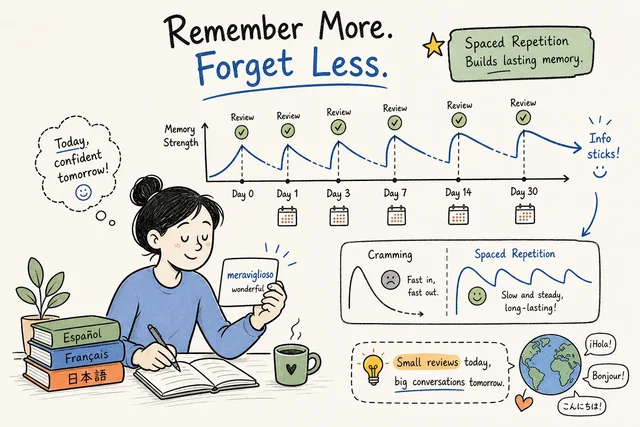
Review due cards before you learn anything new, every session. Retrieval beats rereading, and research on the spacing effect shows that reviewing at increasing intervals produces far stronger retention than massed practice. A practical interval heuristic that works well for a ten-minute daily budget: review after one day, then three, then seven, then fourteen, then thirty. This is a common scheduling heuristic rather than a fixed rule, your SRS app will adjust it automatically, but it gives your queue a manageable shape while locking in long-term memory.
Learn in context and by theme
Study words inside short sentences or mini-dialogues rather than as isolated translations. Group vocabulary by situation: food, travel, work, daily routines. When you add a new word, note one collocation alongside it, "äta frukost" rather than just "frukost," for example. Learning in context and with collocations substantially improves retention because the brain builds more than one retrieval path to the same word.
Micro-output right after input
After any listening or reading clip, produce something immediately. Write or say two lines using the new word. Try first-person, then second-person: "Jag dricker kaffe" then "Du dricker te." This variation forces flexible retrieval rather than rote repetition. If you shadowed a clip, paraphrase it in your own words afterward. The paraphrase is harder than the shadow, and that difficulty is what drives retention.
Keep new items tiny and reviews clean
Add one to three new words per day and stop. If reviews start eating more than seven minutes of your ten, pause new additions for two to three days and let the queue clear. When a card feels impossible, reset it to a shorter interval rather than forcing the full gap. Sustainable consistency outperforms any aggressive learning schedule.
Your 4-week plan for measurable gains
Week 1: lock the habit and core 100
Run the full ten-minute Swedish practice session every day without exception. Add one to three new words per session and aim for sixty to eighty total card reviews across the week, a practical target that keeps the queue manageable at this stage. In Artikulera, focus on en versus ett for the most common nouns: household items, food, body parts. Set up the widgets and streak reminders on day one so the habit has structural support from the start.
Week 2: expand to 200-300 words and add voice
Keep ten minutes as your daily anchor. On two days this week, add a two-minute bonus shadow block after the main session (twelve minutes total on those days only). Track two metrics: total cards reviewed and total minutes shadowed. Watching both numbers grow is more motivating than logging "study time" as a vague concept.
Week 3: grammar micro-sessions that pay off
Rotate Artikulera's three practice modes across the week: article (en/ett) on some days, definite suffix on others, plural endings on alternating days. All three forms are tied to grammatical gender, so rotating them builds a more complete mental model rather than a partial one. Run one Time Challenge midweek to move familiar words from memorized to genuinely instinctive.
Week 4: mix contexts and ship a tiny showcase
Alternate vocabulary topics daily this week: food one day, travel the next, workplace the day after. On the final day, record a sixty-second self-introduction using words you have studied this month. End-of-week check: count your matured cards (those reviewed at the fourteen-day interval or beyond), listen to the recording, and run a fresh set of nouns in Artikulera to check your en/ett accuracy. These three numbers tell you exactly where you stand.
Keep your daily Swedish routine alive when life gets busy
The 5-minute emergency routine
When ten minutes is genuinely impossible, do the abbreviated version: three minutes of SRS reviews, one minute of shadowing, one minute of recap. Five minutes maintains the habit and keeps your review queue from piling up, a pragmatic option grounded in the same microlearning strategies as the full session. If you miss a day entirely, do not try to compensate with a two-hour marathon. Stack two ten-minute sessions over the weekend and move on.
Streaks, widgets, and gentle nudges
Artikulera's Daily Noun and rule widgets show up on your home and lock screen without requiring you to open the app. They function as passive reminders that build familiarity with patterns you are actively working on. Set a calendar nudge at your least chaotic time of day, morning coffee, lunch, or the ten minutes before bed. The best time to practice is the time you will actually do it.
When reviews pile up, do this
Triage first: finish all due reviews before adding a single new word. Do that for two to three days until the queue is clear. Reset hard cards to shorter intervals instead of grinding against the same difficult item every session. Keeping sessions under ten minutes protects consistency, and consistency is the only thing that produces measurable gains over weeks and months.
Simple ways to quantify progress
Progress you can feel is good; wins you can count are better. Track four numbers: streak days, words matured to the fourteen-day interval or beyond, total minutes shadowed this month, and a monthly sixty-second self-recording. Compare the recording from week one to week four. The difference will be audible, and that is the most honest progress report you can give yourself.
Ten minutes, done right, is enough
The sequence matters more than the duration. Retrieve first to prime the brain, add new input in context second, produce micro-output third. That order mirrors how durable memories are built, and it fits inside ten minutes with room to spare.
Try one session today using the structure above. Schedule tomorrow's at the same time. For the grammar anchor of that daily Swedish practice routine, particularly the en/ett instincts that trip up almost every learner, Artikulera is designed for exactly this: short, focused sessions that build real confidence one noun at a time.
Many learners notice measurable improvements within a month when they consistently follow this kind of routine: more words recognized on first hearing, smoother shadowing, and a more reliable reach for en or ett rather than a guess. That is not an extraordinary outcome for ten minutes a day of structured practice. It is simply what consistent retrieval does over time.

Practice Swedish en/ett with Artikulera
Spaced repetition, 30 rules of thumb, and 4,500+ nouns. Free to download.
Free · iPhone & iPad · iOS 17.6+
Frequently asked questions
- What is the best 10-minute routine to practice Swedish?
- Follow a sequence: retrieve first, input second, output third. Do a 60-second cold recall of yesterday's words (say articles aloud), a 3-minute SRS flashcard drill, a 3-minute listening plus shadowing pass, and a 1-minute recap with two original sentences. This ordering leverages spaced repetition and active recall for better retention than unfocused longer sessions.
- How should I use flashcards in a 10-minute Swedish session?
- Run 8-12 cards with active recall and say the answer before you flip the card. Prioritize high-frequency words and add only one to three new items per day so your review queue stays within ten minutes. Timed drills encourage fast, instinctive recall rather than slow reasoning.
- How can I practice en/ett effectively in short sessions?
- Always retrieve nouns together with their article aloud (for example, "ett bord," not just "bord") during the warm-up and flashcard drill. Use timed article drills or Time Challenges to force instinctive responses and repeat quietly if you're in public - whispering still counts. This habit trains your en/ett instincts over time.
- What listening materials work for a 3-minute shadowing drill?
- Pick a one-to-three minute clip and listen once for gist, once for detail, then shadow on the third pass copying rhythm and vowels. The article recommends Coffee Break Swedish's One Minute Swedish playlist on YouTube and SwedishPod101's "Swedish in Three Minutes" series as reliable sources. After shadowing, record about twenty seconds of yourself and listen back for quick pronunciation feedback.
- How do I turn recognition into active use in one minute?
- Use the final minute to produce two original sentences using that day's target words, not the lesson examples. This micro-output step pushes vocabulary from passive recognition into active use, which is essential for speaking. Log one small metric - cards reviewed or minutes shadowed - before you finish.
- Can 10 minutes a day really beat longer study sessions?
- Yes - if the ten minutes are well-sequenced and focused on spaced retrieval and active recall. The article argues that frequent micro-sessions designed around retrieval, input, and output create more durable learning than longer passive sessions or rereading. Consistency over time is the key; cramming does not produce the same gains.
- How should I track progress and structure a four-week progression?
- Track simple metrics like cards reviewed or total minutes shadowed each session so you can measure incremental gains. Keep the daily routine the same, limit new vocabulary to one to three items per day, and repeat the sequence reliably for four weeks to let spaced repetition compound. The article emphasizes consistency and small, measurable wins rather than big one-off efforts.