Language learning streaks: asset or anxiety?
The psychology of daily tracking - why streaks work, where apps get them wrong, and what good streak design looks like.

Every major language learning app uses streaks. The idea is simple: track consecutive days of practice, make the number visible, and let the psychology do the rest. It works - sometimes remarkably well. Duolingo's own data shows that learners who reach a 7-day streak are 3.6 times more likely to complete their course. The psychology is real, well-documented, and powerful.
But there's a paradox at the heart of streak design. One gamification expert puts it plainly: the feature that works best is also the one that fails hardest. The longer a streak runs, the more it hurts to lose - and when it breaks, users quit at higher rates than those who never built a long streak in the first place. The tool that was supposed to build a habit becomes the reason the habit dies.
So what separates a streak system that genuinely supports learning from one that creates anxiety? And how should an app be designed so the streak works for the learner - not against them?
Why streaks work - and why language learning is a legitimate case
Loss aversion and the Zeigarnik effect
Loss aversion - established by Kahneman and Tversky in their 1979 prospect theory research - shows that people feel losses approximately 2.25 times more intensely than equivalent gains. A streak of 47 days doesn't feel like 47 small wins. It feels like a 47-unit loss waiting to happen.
The Zeigarnik effect adds a second layer: incomplete tasks stay mentally prominent in ways that finished ones don't. An active streak functions as an open loop - a persistent background awareness that today's practice hasn't happened yet. No notification required. This combination is what makes streaks such a powerful behavioral driver: they're both something to protect and something that stays top of mind on its own.
Why daily practice genuinely matters for language learning
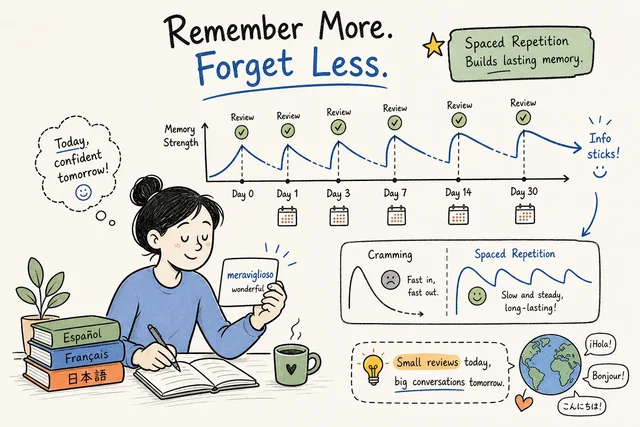
Not every skill benefits equally from daily repetition. Streaks work best when the underlying activity genuinely improves with short, consistent sessions - and language learning is one of the clearest cases. Research on spaced repetition consistently shows that distributing practice across many short sessions outperforms equivalent time spent in a single block. Ten minutes of vocabulary practice every day encodes words more durably than seventy minutes once a week - not because of effort, but because of how memory consolidation works during the gaps between sessions.
Research by Phillippa Lally at UCL found that habit formation takes an average of 66 days, with the first seven days carrying the highest dropout risk. That's exactly the window Duolingo's 7-day data targets: the streak is trying to push learners past the period where most habits collapse before they've had a chance to take hold.
Where streak design goes wrong
The churn paradox
The most counterintuitive finding about streaks is that users who break long streaks often quit at higher rates than users who never built long streaks at all. As the same gamification expert puts it, "the better they work, the worse they fail." This is a direct consequence of how loss aversion scales: the higher the streak, the more catastrophic losing it feels, and when the loss feels large enough, stopping entirely starts to seem rational.
This means the feature most effective at building long-term engagement is also the feature most likely to destroy it when it fails. Streak design that doesn't account for this failure mode ends up punishing its most committed users.
Hollow engagement
A well-documented failure mode of streak systems is hollow engagement: users doing the minimum needed to protect a counter rather than the work that would actually improve their language. The learner who taps through a 60-second lesson at 11:58 PM isn't practicing - they're protecting a number. The counter goes up. The learning doesn't.
This is what happens when the streak becomes the goal rather than the means. Engagement metrics look healthy. The learner isn't actually improving. Eventually they notice that nothing is sticking and stop for an entirely different reason.
Shame as a design tool
Some apps have historically used shame-adjacent design to reduce streak breaks: prompts like "Are you really going to give up now?", paid streak recovery, and all-or-nothing framing that makes a missed day feel like a total failure. UX research on streak design shows this approach produces short-term activity gains at the cost of long-term trust. Users can feel the difference between a streak that serves them and one that serves the app's metrics.
What good streak design looks like
Forgiveness built in, not sold separately
The clearest signal of well-designed streak mechanics is what happens when a user misses a day. Good design builds forgiveness into the structure - not as a purchasable add-on, but as a designed part of the system. Duolingo's own research found that doubling the availability of streak protections increased daily active learners by 0.38 percent. More slack, not less, made the habit more durable.
The distinction that matters is automatic versus purchased. Forgiveness that requires payment signals that a missed day is a punishment to buy your way out of. Forgiveness that activates automatically signals that the system was designed for real people with real lives. The mechanics are similar; the design intent is entirely different.
Flexible daily goals
A fixed daily requirement creates a single point of failure. When schedules vary - as most do - a rigid target means harder days always risk the streak. UX research on streak mechanics found that separating the streak from a fixed daily goal - letting users set their own target - increased 7-day streak retention by around 40 percent. A goal the learner sets themselves is more likely to be hit, because it was realistic for their actual life to begin with.
An ambitious learner sets a demanding daily target. A learner with a newborn at home sets a minimal one. The streak tracks commitment to a self-chosen goal - not compliance with an externally imposed quota. That difference matters for both motivation and trust.
Milestones, not just counters
A streak of 47 days is a number. A milestone at 30 days - named, celebrated, shareable - is a meaningful event. Good streak design turns raw duration into recognizable stages that give learners something specific to aim toward, rather than just an ever-growing counter to protect. Milestones shift the framing from "don't lose this" to "reach the next one" - which is a fundamentally less anxious way to track progress over time.
How Artikulera approaches streaks
Artikulera's streak system was built with these failure modes in mind. The goal was to make the streak an honest record of consistent practice - a genuine habit anchor, but not so fragile that ordinary life destroys it.
Skyddsdagar - built in, no purchase required
Grace days (skyddsdagar) are part of the system structure, not an upsell. After seven consecutive days of practice, a skyddsdag activates automatically if you miss a day - no friction, no charge. The streak continues. A missed day is treated as a normal life event, not a penalty.
This matters both practically and psychologically. Practically: a busy Tuesday doesn't erase three weeks of work. Psychologically: it removes the low-level anxiety that builds up around streaks with no protection - the background awareness that one bad day could wipe everything.
Semesterläget for longer breaks
For planned absences - travel, illness, a week where life simply takes over - vacation mode (semesterläget) pauses the streak for up to 14 days. The pause is a deliberate choice, not a failure. When you return, the streak picks up where it left off.
This shifts the relationship between the learner and the streak from adversarial to collaborative. The streak isn't trying to catch you out. It's a record of your consistency, held until you're back.
A daily goal you set yourself
Rather than a fixed daily requirement, Artikulera lets you choose your own target: 1 noun (Busenkelt), 10 (Lagom), 20 (Kämpigt), or 40 (Stentufft). The streak tracks whether you hit your own goal - not a quota the app decided for you. Raising the target takes effect immediately; lowering it takes effect the next day. That asymmetry is intentional: it prevents gaming the goal downward at the end of a hard day just to protect a counter.
Streak milestones
Milestones mark the streak at 4, 7, 14, 21, 30, 60, 90, 180, and 365 days - each one a named achievement with its own shareable card. The milestones give learners something to aim toward between raw day counts, and each represents a real stage in habit formation rather than an arbitrary number to clear.
Together, these features reflect a specific design intent: a streak should track genuine consistency, survive normal life without punishing it, and feel like something you earned - not something you're always one bad day away from losing.

Practice Swedish en/ett with Artikulera
Spaced repetition, 30 rules of thumb, and 4,500+ nouns. Free to download.
Free · iPhone & iPad · iOS 17.6+
Frequently asked questions
- Do language learning streaks actually improve outcomes?
- Streaks work because they trigger loss aversion - the tendency to feel losses more intensely than equivalent gains. Duolingo's data shows learners who reach a 7-day streak are 3.6 times more likely to complete their course. They also trigger the Zeigarnik effect: an active streak is an open mental loop that keeps practice top of mind. The underlying reason streaks fit language learning specifically is that daily distributed practice outperforms equivalent time in one block - spaced repetition is how vocabulary consolidates.
- Why do I feel anxious about losing my language learning streak?
- Loss aversion research by Kahneman and Tversky shows that people feel losses approximately 2.25 times more intensely than equivalent gains. A 50-day streak doesn't feel like 50 small wins - it feels like a 50-unit loss waiting to happen. The longer the streak, the more painful the potential loss, which is why high-streak users often quit at higher rates after a break than users who never built a long streak at all.
- What happens to my progress if I break a language learning streak?
- Your actual learning - vocabulary retained, grammar patterns internalized - is entirely separate from the streak counter. Breaking a streak does not erase knowledge. The risk is psychological: some learners experience a 'what's the point' reaction after a break and stop practicing. Good app design prevents this by providing automatic forgiveness mechanisms like grace days and vacation modes that distinguish a missed day from a genuine break.
- What is a grace day or streak freeze in a language app?
- A grace day protects your streak when you miss a single day, without a purchase or manual action. In Artikulera, skyddsdagar (grace days) activate automatically after seven consecutive days of practice. This structural forgiveness means a busy day doesn't erase weeks of work, and the streak continues to reflect genuine consistency rather than perfect attendance.
- How long does it take to build a daily language learning habit?
- Research by Phillippa Lally at University College London found that habit formation takes an average of 66 days, ranging from 18 to 254 depending on the behavior. The first seven days carry the highest drop-off risk - which is exactly why Duolingo's data shows a 3.6x completion jump at the 7-day mark. Streak design is specifically trying to push learners past this window.
- What makes a language streak system helpful rather than stressful?
- Three design principles separate helpful streaks from stressful ones: forgiveness built in automatically rather than sold as an add-on; daily goals the learner sets themselves rather than a fixed external quota; and named milestones at meaningful intervals that give learners something to aim toward. When these are in place, the streak rewards genuine consistency without punishing normal variability.