The Most Important Grammar Topics for the SFI Exam
Which Swedish grammar topics most affect your score — and where to put your time first.
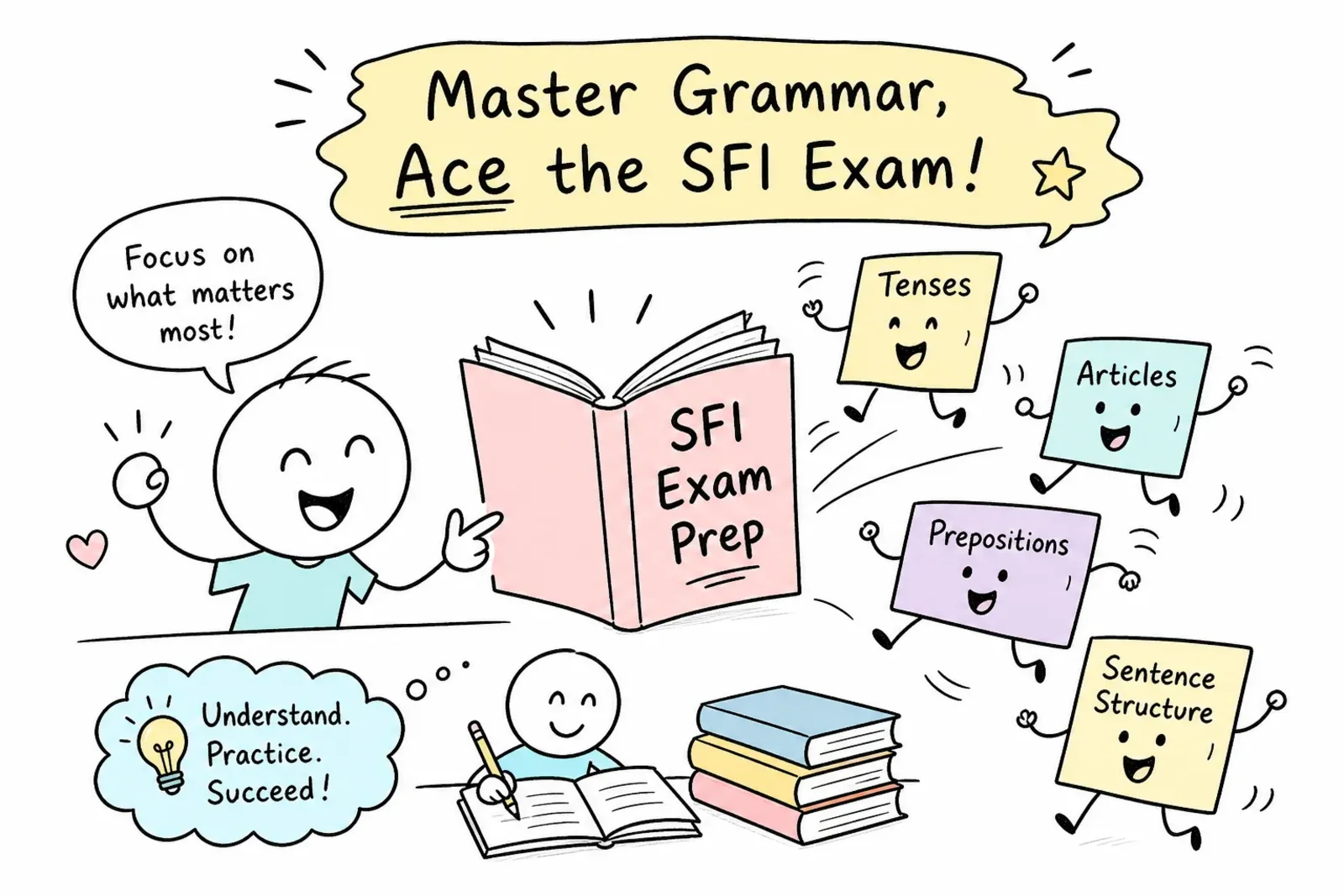
Almost every SFI student opens a grammar textbook, starts on page one, and works through it in order. By week three they've spent hours on topics like adjective comparison, which barely surfaces in the exam, while barely touching word order — which can single-handedly sink a writing task at level C or D. The root cause is almost always the same: studying grammar without knowing which parts actually determine your score.
This article ranks the grammar topics most important for the SFI exam, explains why each one matters, and gives you a clear sense of where to put your time first. One thing worth knowing before you start: the SFI national exam does not have a grammar section. Grammar is assessed through writing and reading tasks, which means the skill you're actually building is not the ability to identify rules but the ability to produce correct Swedish under pressure, in real time.
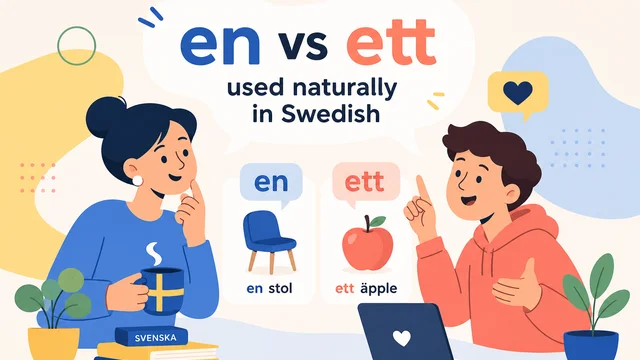
There's also a practical shortcut hidden in how Swedish grammar is structured. Several topics are connected at the root. Noun gender — whether a noun is en or ett — determines which definite suffix to use and how adjectives must agree, and it also influences which plural ending applies. Fix the root and you address three problems at once. This is exactly the pattern that Artikulera was built around, working with SFI teachers to target the en/ett system before anything else.
How grammar is actually tested in the SFI exam
The SFI national test runs at levels B, C, and D, and it does not include isolated grammar questions at any of them. Instead, grammar surfaces in writing tasks, where your sentence structure, tense choices, and word order either hold together under the assessor's eye or they don't. At course C, the exam includes one writing task. At course D, there are two. The pass or fail outcome depends heavily on whether the text you produce is coherent, intelligible, and structurally controlled. For official information about test structure, see Stockholm University's SFI test overview.
You are not preparing to recognize grammar errors in someone else's text. You are preparing to produce correct Swedish while thinking about content, vocabulary, and time at the same time. That requires automaticity, not just awareness.
What each SFI level actually demands
SFI A and B sit roughly at the A1 to A2 range on the CEFR scale. The expectation is basic clause control: present tense, simple past, yes/no questions, and everyday vocabulary in short exchanges. SFI C moves into A2+ territory, where connected sentences, some tense contrast, and functional sentence structure become the standard. SFI D pushes into B1 — multi-clause texts, independent tense use across a narrative paragraph, and control of subordinate clause structure.
Why grammar errors hurt more in writing than in speaking
In a spoken exchange, intonation, body language, and shared context do a lot of the communicative work. In a written paragraph, none of those rescue mechanisms exist. Grammar carries the full weight of meaning, and a wrong verb form or broken word order signals weak language control to an assessor in a way that the same error in speech rarely does.
Noun gender — the grammar topic with the highest leverage
Whether a noun takes en or ett is not just one question with one consequence. It is the variable that shapes everything downstream: the definite suffix (-en vs. -et), the adjective form that must agree with the noun, and the plural ending. Get the article wrong on a single noun and you can generate three or four errors in the same sentence without making a single additional mistake.
Here's what that looks like in practice. Take problem, which is an ett noun. Correct forms: ett problem, problemet, ett stort problem. If a learner misclassifies it as an en noun, they may write en problem, problemen, and en stor problemen — three errors from one misidentified gender. The en/ett distinction is not one item on a checklist. It's the root that feeds several others.
How Artikulera targets exactly this skill
Many general language apps treat en and ett as one flashcard among thousands. Artikulera is built around the en/ett system as a core focus, which is what makes it well-suited for SFI preparation. The app combines over 4,500 nouns with 30 learnable patterns and uses a spaced repetition algorithm that surfaces nouns right before you're likely to forget them. The patterns cover a broad range of Swedish nouns by suffix or category, so you're building a system that lets you make a confident judgment on a word you've never seen before — the kind of instinct that C and D writing tasks reward.
Swedish word order: V2 and the BIFF rule
After noun gender, word order is the topic SFI teachers name most consistently when asked what separates candidates who pass at C and D from those who don't. Swedish is a V2 language — the finite verb must always sit in second position in a main clause. When a time expression or adverb opens the sentence, the subject and verb invert.
Main clause V2 in practice
A common error pattern among English-speaking SFI learners involves exactly this point. English does not require inversion after a fronted time expression, so the Swedish pattern feels unnatural and must be actively reprogrammed. Compare: I dag jag arbetar (incorrect) versus I dag arbetar jag (correct). Once you internalize that rule as a reflex, it stops costing you errors in every third sentence of a writing task.
The BIFF rule for subordinate clauses
The BIFF rule governs what happens in subordinate clauses (bisatser). The mnemonic stands for "I bisats kommer inte före det finita verbet" — in a subordinate clause, inte and other clause adverbs come before the finite verb rather than after it. This is the reverse of main clause order, and it's a C/D level distinction that separates basic communicators from those who can write structured, multi-clause paragraphs. Compare: Jag vet att hon inte arbetar (correct) versus Jag vet att hon arbetar inte (incorrect). For clear examples and practice, see WordDive's guide to word order in subordinate clauses.
Verb tenses and verb forms across SFI levels
At A and B, the priority is reliable presens and simple preteritum. At C and D, assessors expect supinum used correctly with har, infinitive forms with modal verbs, and the ability to move between tenses deliberately across a narrative paragraph without accidentally mixing them.
The four verb groups
Groups 1 and 2 follow predictable rules: group 1 adds -ade / -at, group 2 adds -de or -te / -t. Groups 3 and 4 are where most errors cluster. Group 4 includes strong verbs where vowel changes must simply be learned. The high-frequency irregular verbs are a manageable short list: vara, ha, gå, komma, se, göra, ta, säga, få, skriva. Knowing those ten thoroughly addresses a large share of tense errors that appear in SFI-level writing.
The presens-preteritum-supinum sequence
SFI assessors at C and D look for consistent tense use across a paragraph. Presens covers current and habitual action, preteritum covers completed past events, and har + supinum covers action with a connection to the present. Mixing these three within a single paragraph without a clear narrative reason is one of the most common reasons writing tasks lose marks.
Adjective agreement, pronouns, and clause-linking
Adjective agreement flows directly from noun gender — one more reason to solve en/ett first. The three-form pattern: an indefinite en noun takes the base adjective form (en stor bil), an indefinite ett noun adds -t (ett stort hus), and any definite or plural noun adds -a (stora bilar, den stora bilen).
Beyond adjectives, SFI D assessors expect learners to use subordinating conjunctions rather than chaining simple main clauses with och. Connectors like eftersom, trots att, när, and om are what push a C-level text toward D-level fluency. They also trigger the BIFF rule, so practicing conjunctions and subordinate clause word order together is more efficient than practicing them separately.
A practical grammar priority plan by SFI level
What to lock in at SFI A and B
At A and B, prioritize noun gender and definite forms, basic presens and preteritum, yes/no and information questions, and the ten core prepositions in their most common contexts. Getting these right with enough automaticity before moving to C prevents a cascade of compounding errors later. Daily short practice on en/ett pays the largest dividend at this stage, because every hour invested here reduces errors across multiple other grammar areas simultaneously.
What to focus on at SFI C and D
At C and D, the priority shifts to V2 word order and inversion, the BIFF rule, full tense contrast, adjective agreement, and conjunctions for multi-clause sentences. These directly determine whether a writing task reads as controlled B1-level Swedish or as a string of basic clauses that never quite connect.
For noun gender, a short daily session with Artikulera remains one of the most efficient ways to reach the automaticity that C and D writing tasks demand. For additional curated materials, see this list of Swedish grammar resources compiled for learners at different levels.
Where to start
It's not about knowing every rule. It's about knowing which topics appear most in assessed writing and building enough automaticity that the correct form comes out without slowing you down. The priority order: noun gender and definite forms first, then V2 word order and the BIFF rule, then tense control, then adjective agreement and clause-linking.
Noun gender underpins several other grammar topics, which makes it a high-leverage starting point. Solving it first doesn't just reduce en/ett errors — it reduces definite form errors, adjective agreement errors, and related plural errors at the same time. Begin there, build systematically, and the rest of the grammar falls into a pattern that's much easier to internalize than it looks from the outside.

Practice Swedish en/ett with Artikulera
Spaced repetition, 30 rules of thumb, and 4,500+ nouns. Free to download.
Free · iPhone & iPad · iOS 17.6+
Frequently asked questions
- Which grammar topics should I prioritize for the SFI exam?
- Focus on high-impact areas: noun gender (en and ett), word order (V2 and the BIFF rule), tense control, subordinate clause structure, adjective agreement, and common plural endings. These topics most directly affect how coherent and structurally controlled your writing looks to an assessor.
- Why is noun gender (en and ett) so important for SFI?
- Noun gender determines the definite suffix, adjective agreement, and which plural ending applies — so mastering en and ett fixes several grammar issues at once. Targeting the en/ett system early is an efficient shortcut used by SFI teachers and platforms like Artikulera.
- How is grammar actually tested on the SFI national exam?
- There is no isolated grammar section. Grammar is assessed through reading and writing tasks, so your ability to produce correct Swedish under time pressure matters more than rule recognition. The national test runs at levels B, C, and D and assessors judge coherence, intelligibility, and structural control in candidates' texts.
- What grammar is expected at SFI course C compared with course D?
- SFI C corresponds roughly to A2+ on the CEFR and expects connected sentences, some tense contrast, and functional sentence structure. SFI D moves toward B1 and requires multi-clause texts, independent tense use across a paragraph, and control of subordinate clauses.
- How many writing tasks are there on the SFI national test at course C and D?
- At course C the exam includes one writing task, while course D includes two writing tasks. Success depends on producing coherent, structurally controlled texts in those tasks.
- How should I study grammar to improve my SFI writing score?
- Practice producing whole sentences and short texts under time pressure so correct forms become automatic, not just recognizable. Prioritize root systems (en/ett, word order, tense control, subordinate clauses) and do writing practice that mirrors exam conditions.
- Why do grammar errors hurt more in writing than in speaking?
- Spoken interaction benefits from intonation and shared context that often mask small errors, but written text has no rescue mechanisms. A wrong verb form or broken word order in writing signals weak control to an assessor more clearly than the same mistake would in speech.