Do Language Apps Help You Pass SFI? An Honest Guide
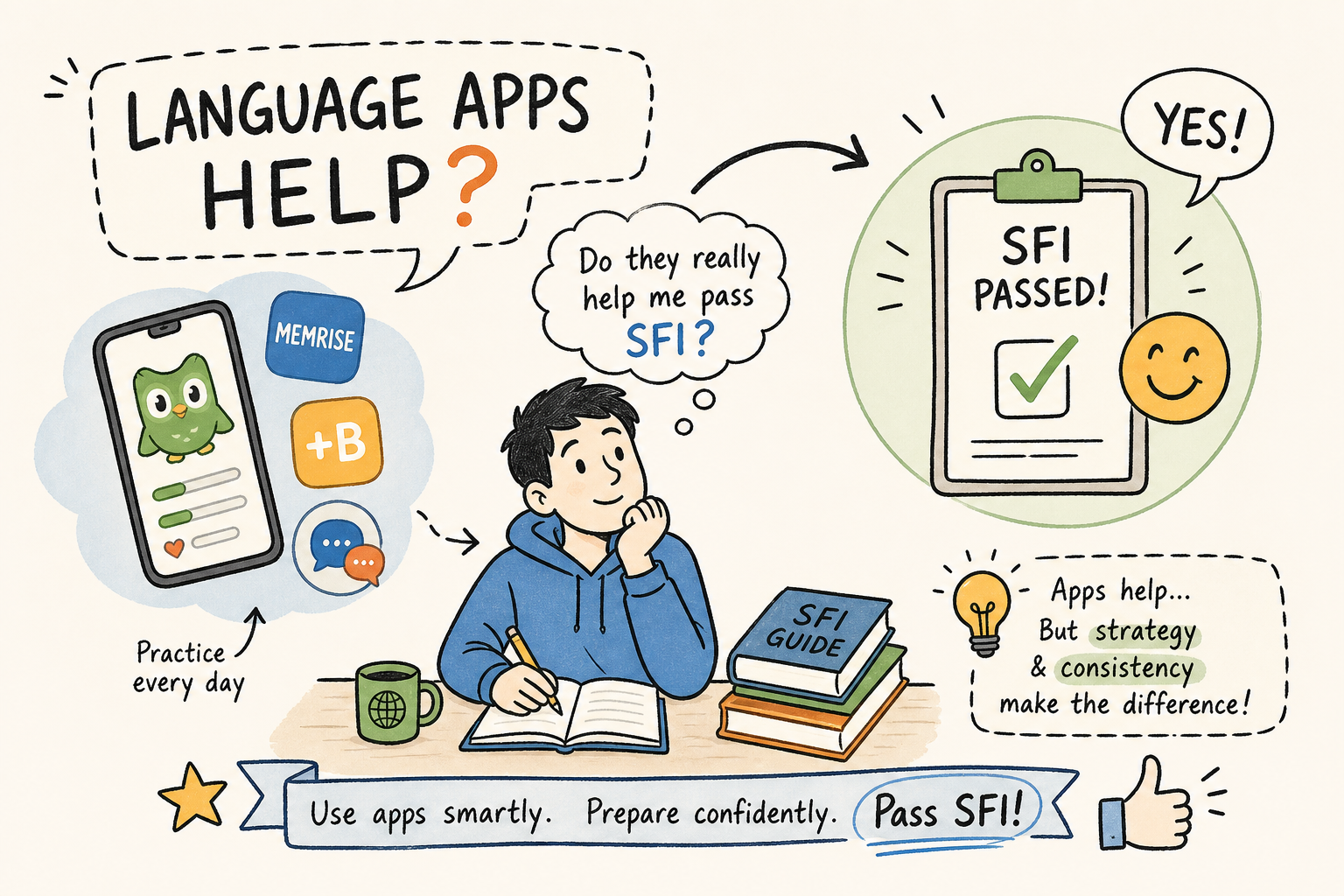
Can a language app help you pass the Swedish SFI course? Many learners download Duolingo the night before their first class, complete three lessons, and feel ready. Six months later, they're struggling with writing tasks, article agreement is a mess, and they're wondering what went wrong. Apps were supposed to make this easier.
The honest answer: language apps can help you pass the SFI course, but the outcome depends entirely on which apps you choose and how you fit them into your study routine. General apps cover a lot of ground but miss some critical grammar. Artikulera, a mobile app built in collaboration with SFI teachers, was designed to fill the exact grammar gap that sinks most learners. This guide covers what SFI actually measures, which app features map to those skills, and a concrete 12-week plan for blending app practice with classwork.
What the SFI exam actually tests
The four skills assessed at every level
SFI (Swedish for Immigrants) national tests at levels B, C, and D all measure the same four skills: reading comprehension, listening comprehension, writing, and speaking. According to Skolverket, the tasks are drawn from everyday life, work, and society contexts, and a typical sitting runs four to five hours. Understanding this structure is your starting point when evaluating any Swedish learning app, because not every app trains all four skills equally.
At level B, the exam includes two listening sections, two reading sections, one writing task, and one oral task. By level D, students face two extended writing tasks, a solo oral task, and a paired discussion. The gap between B and D is significant. The skills that get you through level B are not sufficient for D, which means any app layer you build needs to scale with your level progression.
The grammar elements most learners underestimate
Beyond the four-skill structure, specific grammar patterns run through every SFI level and commonly trip up learners who underestimate them. Swedish word order, specifically the V2 rule, is one. Grammatical gender, the en/ett system governing articles, definite suffixes, and plural endings, is the other. Many teachers report that learners treat these as minor vocabulary details rather than the structural rules they are.
Getting the article wrong cascades through an entire sentence. When you write the wrong article, the definite form follows suit, the plural is often wrong as well, and the whole sentence signals grammatical insecurity to an examiner. On the SFI writing and speaking components, article errors are the kind of recurring mistakes that pull scores down, and they are preventable with targeted practice.
Can a language app help you pass the SFI course? What the features tell you
Spaced repetition vs. passive scrolling
Not all practice is equal. Apps that use spaced repetition, surfacing words just before you would naturally forget them, produce measurably better retention than apps that cycle through the same word list in the same order every session. For SFI vocabulary building, spaced repetition is the most research-backed feature to look for. A University of Sheffield study tracking 337 adult learners found that app-based learners outperformed classroom learners on receptive grammar and vocabulary measures, with spaced review central to that advantage.
Grammar-focused drills vs. phrase memorization
Many popular Swedish language apps teach phrases and conversational chunks without explaining the grammar patterns underneath. For SFI, that approach breaks down quickly because the exam requires productive grammar use, not just recognition. An app that explains rules, shows patterns, and drills those patterns systematically does more for SFI readiness than one built around translation games.
Duolingo's Swedish course includes short grammar tips covering topics like en/ett noun gender and definite suffixes, and it explicitly aligns to CEFR A1 through B1, content that overlaps with some SFI course competencies. What it does not do is go deep on the many patterns that govern which nouns take which article. It notes en and ett, then moves on. For exam-level writing and speaking accuracy, noting a rule is not the same as internalizing it.
Speaking and listening tools: what actually transfers
Apps vary significantly on speaking and listening practice. The SFI listening and speaking tasks use recorded interviews, conversations, and news-style audio. An app that exposes you to natural-speed Swedish speech and asks you to respond prepares you better than one that keeps everything text-based. The same University of Sheffield research found that classroom learners outperformed app-only learners on listening comprehension, a clear signal that this is where apps have the biggest gap and where classroom time earns its value.
The apps worth using for SFI prep (and where each falls short)
Duolingo and Babbel: useful starting points
Duolingo explicitly aligns its Swedish course to CEFR A1 through B1, which covers content that overlaps with SFI B through early D competencies. It includes short grammar tips, listening tasks, and some speaking components. Babbel covers beginner-to-intermediate material with structured lessons and a reasonable vocabulary foundation. Both apps are genuinely useful for building initial vocabulary and getting familiar with Swedish sentence patterns, and both are worth using in the early weeks of SFI prep.
The limitation is not that these apps are bad, it is that they are broad. A general Swedish language practice app is designed to cover the whole language at a surface level, not to go deep on one grammar layer. For casual learning, that breadth is fine. For SFI exam readiness, it leaves a gap.
Artikulera: purpose-built for the problem general apps skip
Artikulera was built in collaboration with SFI teachers, and that origin shapes how the app works. According to the app's documentation, it is built around the en/ett system: 4,500+ nouns, 30 learnable rules of thumb with individual mastery tracking, spaced repetition tied to Ebbinghaus memory research, and timed practice modes designed to push words from memorized to genuinely instinctive. For SFI students, this addresses the exact gap that general apps leave open.
Artikulera does not try to replace a general app for vocabulary breadth. Its stated focus is the one grammar layer that consistently trips up SFI learners and that other apps treat as a footnote. The app's three practice modes cover article selection, definite suffix, and plural endings, the forms tied to grammatical gender that appear on the SFI writing and speaking tasks. Using Artikulera alongside a broader vocabulary app is the combination that maps most directly to what the exam actually tests.
App-only vs. blended study: what the research actually shows
Where apps help you pass SFI: grammar and vocabulary gains
The University of Sheffield research found that app-based learners outperformed classroom learners on receptive grammar and vocabulary, a result consistent with broader systematic reviews showing that apps are particularly effective for building grammar pattern recognition and vocabulary frequency. Apps also make daily practice easier to sustain because they fit into short windows that a classroom session cannot.
Why blending consistently outperforms either approach alone
The classroom still wins on listening comprehension, and for the paired oral tasks in SFI C and D exams, there is no app substitute for live conversation with a teacher who can respond to your errors in real time. The practical conclusion from the research is not that apps fail, it is that they work best as daily reinforcement for skills that need high repetition, while classroom time handles the communicative skills that require human interaction.
Treating apps as your classroom supplement rather than your classroom replacement is the approach the research supports. A weekly study load of 8 to 10 hours, combining classroom attendance with daily app sessions, gives you both the repetition volume and the communicative practice that SFI levels C and D demand. (Research on successful SFI completers typically cites 8, 15 hours per week as the effective range.)
A 12-week blended study plan for SFI
Weeks 1, 4: Build the grammar foundation
In the first four weeks, prioritize the grammar structures that appear throughout every SFI level. Use Artikulera daily for 10 to 15 minutes to internalize en/ett rules and begin building noun mastery through spaced repetition. Use Duolingo as your broader vocabulary and sentence pattern layer. Aim for roughly 8 to 10 hours of study per week across app practice, classroom attendance, and independent reading of simple Swedish texts.
Use Artikulera's progress tracking from day one to see which rules are becoming instinctive and which still need reinforcement, that data grows more useful as you approach the exam. The goal at this stage is grammar pattern recognition, not perfect recall under pressure; that comes in weeks 9 through 12.
Weeks 5, 8: Expand vocabulary and listening exposure
With the grammar foundation in place, shift more time toward listening and reading practice. Find Swedish podcasts or news audio at A2 to B1 level and work through them alongside your classroom listening practice. Skolverket's official SFI test format uses recorded interviews, conversations, and news-style content, so aligning your listening input to those formats is deliberate preparation, not general study.
Continue daily Artikulera sessions to consolidate the noun lists relevant to work and society topics, the exact contexts the SFI exam uses. By the end of week eight, your progress data should show strong retention on the core rule sets and the most frequent noun categories. Flag any rules still showing weak mastery for targeted review in the final phase.
Weeks 9, 12: Simulate exam conditions and benchmark readiness
In the final four weeks, shift from study mode to test-readiness mode. Download Swedex mock exam materials from Folkuniversitetet, which include listening MP3s, reading comprehension PDFs, and oral examination prompts at A2/B1 and B2/C1 levels. Work through timed practice sets under actual exam conditions: no dictionary, no pausing the audio, no extended writing time beyond what the real exam allows.
Use your mock exam results to drive your final app sessions. If your writing shows article agreement errors, go back to Artikulera and run targeted drills on the noun categories giving you trouble. If listening comprehension is the weak spot, increase your daily exposure to natural-speed Swedish audio. These final weeks are not about covering new ground, they are about converting your preparation record into exam-day confidence.
How to know when you're actually ready
The free benchmarks worth using
Skolverket provides official SFI national test information describing task formats at each level. Swedex mock exams from Folkuniversitetet are the closest freely available approximation of actual SFI exam conditions, covering all four skills with downloadable audio, reading passages, writing tasks, and oral prompts. Working through a complete timed Swedex set and comparing your results against the official passing criteria is the most reliable pre-exam check available for free.
The milestones that signal genuine readiness
You are ready to sit an SFI level exam when you can complete a full Swedex reading and listening session within the allotted time without using a dictionary, produce a coherent written response on an everyday topic with accurate grammar, and hold a short paired conversation without freezing on article agreement. These are not aspirational targets, they are practical benchmarks that map directly to what the exam asks for. If your app's grammar tracking shows strong retention across the core noun categories and rule sets, that is a useful signal that your instincts are developing, though it works best alongside mock-exam results rather than as a substitute for them.
The bottom line on apps and SFI
So, can a language app help you pass the Swedish SFI course? Yes, when you choose the right ones and use them as part of a broader study plan. General apps like Duolingo build vocabulary and sentence structure well, and they are worth using throughout your preparation. Artikulera addresses the grammatical gender layer those apps leave behind, with features developed in collaboration with SFI teachers specifically for this exam context.
Use both tools. Follow the 12-week plan. Benchmark your readiness with official Swedex materials before you sit. When you walk into that exam room, you will have a concrete preparation record behind you, not just a streak count and a hope.

Practice Swedish en/ett with Artikulera
Spaced repetition, 30 rules of thumb, and 4,500+ nouns. Free to download.
Free · iPhone & iPad · iOS 17.6+
Frequently asked questions
- Can a language app help me pass the Swedish SFI course?
- Yes - apps can help you pass SFI, but it depends on which apps you pick and how you use them. General apps cover a lot of ground but often miss critical grammar patterns; Artikulera, built with SFI teachers, was designed specifically to address those gaps. Using apps as a focused supplement rather than the only study method gives the best chance of success.
- What do SFI exams actually test?
- SFI national tests at levels B, C, and D assess four skills: reading comprehension, listening comprehension, writing, and speaking. According to Skolverket, tasks come from everyday life, work, and society, a typical sitting runs four to five hours, and task formats shift with level (for example, level B has two listening and two reading sections plus writing and oral tasks, while level D includes extended writing and paired discussion).
- Which app features matter most for SFI preparation?
- Look for spaced repetition for vocabulary retention, explicit grammar-focused drills that explain and train rules, and activities that practice productive skills (writing and speaking) rather than only recognition. Not every app trains all four SFI skills equally, so choose a combination that fills gaps your classroom work doesn't cover.
- What Swedish grammar points do learners most often underestimate for SFI?
- Learners commonly underestimate Swedish word order (the V2 rule) and the en/ett system governing grammatical gender, definite suffixes, and plural endings. Article and gender errors cascade through sentences and regularly lower scores on SFI writing and speaking unless addressed with targeted practice.
- Is spaced repetition really important for SFI vocabulary?
- Yes - spaced repetition produces measurably better retention than repetitive or random review, making it the most research-backed feature for building SFI vocabulary. A University of Sheffield study following 337 adult learners found app-based learners with spaced review outperformed classroom learners on receptive grammar and vocabulary measures.
- Is Duolingo alone enough to pass SFI?
- Duolingo's Swedish course includes short grammar tips (covering topics like the en/ett system and definite suffixes) and aligns to CEFR A1 through B1, so it overlaps with some SFI competencies. However, its phrase-focused and recognition-based activities may not provide the systematic, productive grammar practice required for higher SFI levels, so it’s best used alongside targeted grammar drills and speaking/writing practice.
- How should I combine apps with my SFI classes?
- Blend apps into a structured routine: use spaced-repetition tools for vocabulary review, a grammar-focused app for drilling V2 and en/ett patterns, and speaking/listening activities that mirror exam tasks. The guide includes a concrete 12-week plan for integrating app practice with classwork so your app use scales with the jump from level B to D.