7 Best Swedish Learning Apps for Beginners (2026)
Choose the right app by goal — vocabulary, grammar, or speaking — and follow a 30-day plan that actually works.
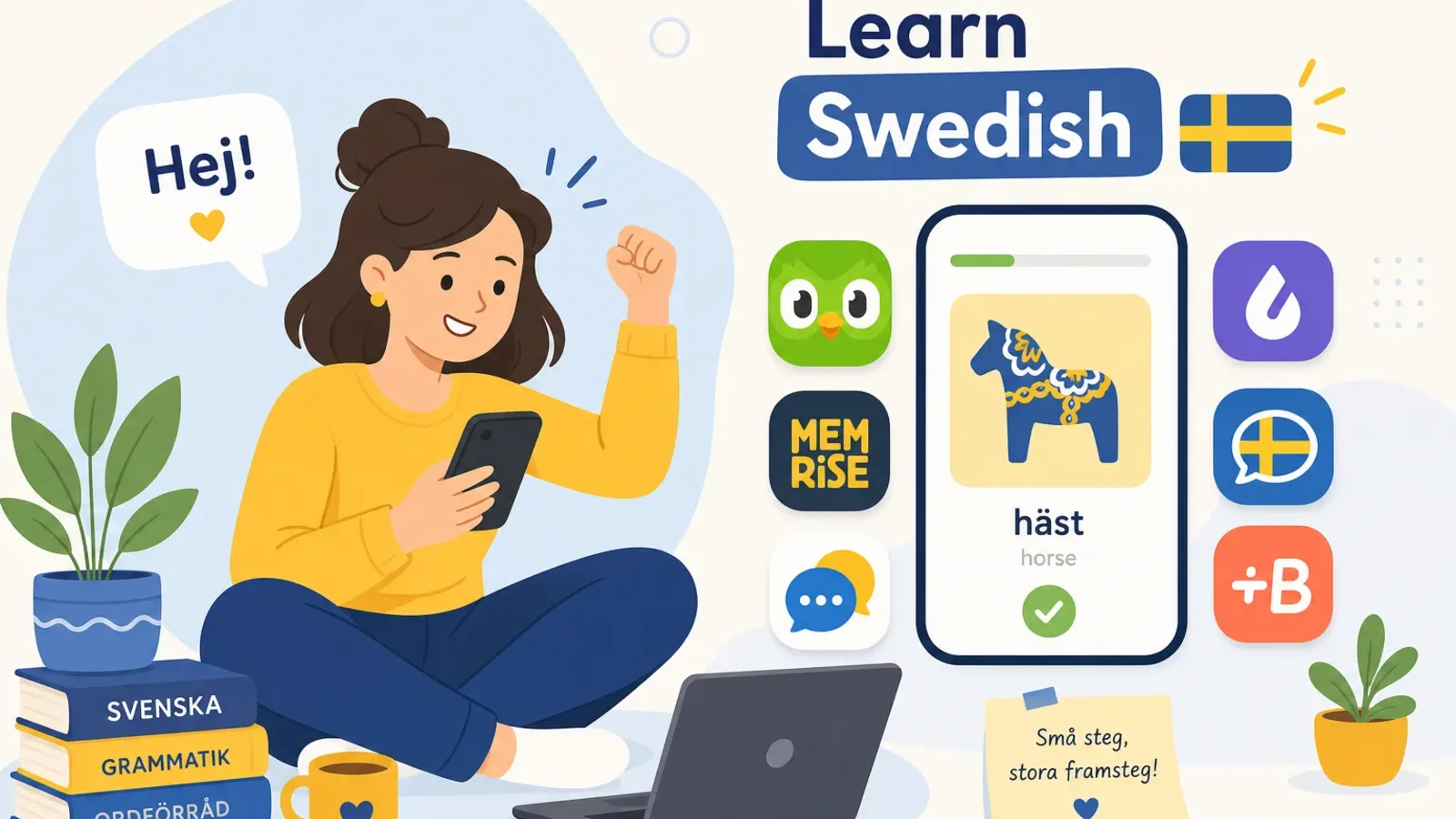
If you've been searching for the best app to learn Swedish for beginners, you've probably noticed that the top results mostly reflect download counts rather than learning outcomes. Swedish is genuinely accessible for English speakers — the Foreign Service Institute classifies it as a Category I language, meaning roughly 600–750 classroom hours to professional proficiency — and many learners find the grammar relatively clean, the pronunciation manageable, and the vocabulary surprisingly familiar thanks to shared Germanic roots.
Most beginners make solid early progress, then hit a wall around weeks three to six that they didn't see coming: every noun in the language carries a grammatical gender, and getting it wrong ripples through the article, definite suffix, and plural ending of every noun in the sentence. That wall is where many learners quit — not because Swedish is too hard, but because the app they chose wasn't built to handle it.
This comparison is organized by learning goal, not by popularity. Whether you want to build vocabulary fast, study with a structured course, prioritize speaking, or fix the one grammar problem that trips up nearly every beginner, there's a specific tool for each job.
How to pick the right Swedish learning app before you download anything
Before you choose, get clear on what you actually need in the next 30 days. Three learning goals drive most beginner decisions. Vocabulary-first learners want spaced repetition, lots of nouns and phrases, and a daily habit they can stick to. Grammar-first learners need pattern explanations, structured feedback, and rules they can apply to new words. Speaking-first learners need native-speaker audio, speech recognition, and real pronunciation coaching. A fourth filter is budget: some of the best apps are free.
Here's what almost no one mentions: most general-purpose Swedish apps are built for vocabulary. They're good at it. But Swedish has a grammatical gender system — the en/ett article distinction — that affects every noun and goes far deeper than vocabulary work alone can fix. Learners who don't account for this early tend to spend months building a vocabulary they can't reliably use in sentences.
Best apps for vocabulary and building a daily study habit
If your first priority is getting traction fast and building a consistent routine before worrying about grammar, gamified vocabulary apps are the right starting point. For a broader roundup, see the Best Swedish Learning Apps of 2026: Ranked and Reviewed.
Duolingo Swedish: the best free starting point
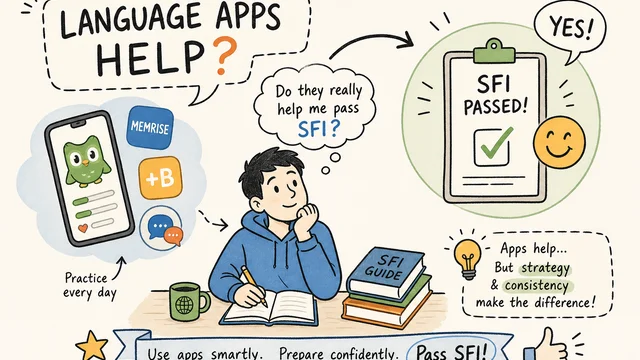
Duolingo is the most accessible entry point for beginner Swedish learners. The free core curriculum is solid for basic vocabulary and common phrases. Bite-sized 5–10 minute lessons, a streak system, and game mechanics make it genuinely easy to build a daily habit without relying on willpower alone. For absolute beginners, that consistency matters more than curriculum depth.
The trade-off is grammar coverage. Duolingo introduces en/ett early but never systematically reinforces it. The course exposes you to gender patterns through repetition, which works for recognition, but it doesn't give you transferable rules you can apply to new words. Super Duolingo runs $12.99/month or $84/year and removes ads while adding unlimited hearts. The free tier is a legitimate starting point.
Drops and Memrise: vocabulary-dense alternatives
Drops takes a different approach: fast-paced, visual word learning in short daily sessions. The free tier limits daily practice time, making it an effective vocabulary accelerator when paired with a grammar-focused tool. Memrise uses community-created decks and native-speaker video clips, giving learners more authentic exposure to how Swedish actually sounds.
Neither app goes deep on grammar. Think of them as vocabulary boosters layered on top of a grammar foundation you're building elsewhere.
Best apps for structured lessons and speaking practice
Babbel: the most structured beginner course for Swedish
Babbel offers one of the clearest lesson-based curricula available for beginner Swedish. Each lesson follows a defined progression from greetings through grammar concepts, with short explanations built into the lesson. Native-speaker audio runs throughout, and the practical vocabulary skews toward real conversations. For learners who want something that feels like a designed course rather than an app, Babbel is the strongest paid option.
Grammar coverage is better here than in Duolingo. Babbel explicitly tells learners that Swedish nouns are common (en) or neuter (ett) and integrates this into its lesson flow. The limitation is the same one that affects most general apps: en/ett is treated as a memorization task. Babbel will tell you the gender of a specific noun; it won't give you pattern-based rules you can use to make an educated guess on a word you've never seen before. For Babbel's own take on grammatical gender, see Babbel's guide to grammatical gender.
Pimsleur: best for pronunciation and audio-first learners
Pimsleur is built around 30-minute audio lessons and oral spaced repetition. You listen, speak, get prompting, and repeat. The method builds oral muscle memory early and is notably strong for pronunciation coaching, making it the top choice for learners whose primary goal is to speak and be understood. Commuters and learners who absorb language through listening consistently find Pimsleur more effective than text-heavy approaches.
The en/ett system in Pimsleur is learned implicitly through phrase repetition rather than explicitly taught. This works for building oral fluency, but it doesn't give you the rule-based understanding that helps with writing or new vocabulary. A free trial is available — see an independent Pimsleur Swedish review for a deeper look.
The grammar gap: why the en/ett system trips up most beginners
Swedish has two grammatical genders: common (en) and neuter (ett). Research on Swedish noun distribution suggests roughly 75–80% of nouns are en-words. Getting gender wrong doesn't just affect the article — it cascades through the definite suffix and the plural ending, so a misassigned gender can produce multiple errors in a single phrase.
General apps teach nouns in isolation. They tell you the gender of each noun as a piece of vocabulary, but they don't teach you the underlying patterns that let you make a confident prediction on a word you've never seen before. Swedish actually has a range of learnable suffix and category patterns that cover the majority of nouns — a system most beginner apps ignore entirely. For a curated list of tools that go deeper on article and gender practice, see 6 Apps That Go Deeper Than Duolingo on Swedish Articles.
How Artikulera goes deeper on Swedish gender
Artikulera (iOS, with Android coming soon) is built exclusively around Swedish grammatical gender. It doesn't try to teach the whole language — it goes deeper on this one skill than any general-purpose app in this comparison. According to the app's documentation, it pairs 4,500+ Swedish nouns with learnable rules of thumb covering the majority of gender patterns, so learners develop a system for handling new words rather than a growing list of memorized exceptions.
The spaced repetition algorithm surfaces nouns right before you forget them, drawing on established memory research. Three practice modes cover the article (en/ett), the definite suffix, and the plural ending — the full scope of what grammatical gender governs in Swedish. The app was developed in collaboration with SFI teachers and is free to download, with a premium upgrade for full access to the noun library.
The right framing: Artikulera isn't "instead of Duolingo or Babbel." It's the grammar depth layer that makes the vocabulary those apps teach actually function in sentences.
Side-by-side: matching apps to your learning goal
- Vocabulary and daily habit: Duolingo (free) or Drops for consistent, low-friction daily practice
- Structured beginner course: Babbel for a teacher-designed curriculum with grammar integration
- Pronunciation and speaking: Pimsleur for audio-first oral practice and early speaking confidence
- Swedish gender mastery: Artikulera as the grammar depth layer, used alongside any of the above
- Budget-conscious learners: Duolingo's free tier plus Artikulera's free tier covers the fundamentals at no cost
Most beginners benefit from two apps working in parallel, not one trying to do everything. The most effective pairing: a vocabulary and habit app (Duolingo or Babbel) combined with Artikulera, introduced around week two or three once the daily habit is established.
Your 30-day beginner plan
This plan assumes 15–20 minutes per day.
Days 1–14: build your vocabulary base and daily habit
Pick one primary app and commit to one lesson per day. If budget is a constraint, use Duolingo. If you want more structure, use Babbel. Aim to reach around 150–200 Swedish words, basic greetings, numbers, and common phrases by day 14 — treat this as a rough benchmark, not a hard target. Focus entirely on input and habit formation. Don't worry about perfect grammar yet.
If speaking is your primary goal, add Pimsleur alongside your text-based app. Pimsleur's 30-minute format works naturally as a standalone daily session for learners who prefer listening to reading.
Days 15–30: add grammar depth and build noun instinct
Introduce Artikulera in week three alongside your primary app. Start with 10 minutes of en/ett flashcard practice daily and work through the app's initial set of gender rules. Focus on recognizing patterns rather than memorizing individual words one at a time. By day 30, your vocabulary app is giving you the words and Artikulera is giving you the gender — sentences start to feel structurally correct rather than just familiar.
Set a streak target in both apps and use Artikulera's home screen widget for passive reinforcement throughout the day. For complementary app lists and comparisons, see a practical roundup of the best apps to learn Swedish.
The bottom line
No single app does everything. The right choice for beginner Swedish learners depends entirely on your primary goal, and the strongest beginner outcomes come from pairing a vocabulary and habit tool with a grammar-depth tool rather than expecting one app to cover both.
For most beginners: Duolingo or Babbel for daily structure and vocabulary, Artikulera for the en/ett system that determines whether your Swedish actually sounds right. Solving the grammar gap early — rather than retrofitting it onto hundreds of nouns you've already learned — is the single highest-leverage move a beginner can make. The 30-day plan above gives you a concrete path to both.

Practice Swedish en/ett with Artikulera
Spaced repetition, 30 rules of thumb, and 4,500+ nouns. Free to download.
Free · iPhone & iPad · iOS 17.6+
Frequently asked questions
- What is the best app to learn Swedish for beginners?
- There's no single best app — it depends on your goal. For vocabulary and daily habit, Duolingo is the strongest free option. For structured lessons, Babbel leads. For speaking practice, Pimsleur is the top audio-first choice. For Swedish gender mastery (the grammar gap most apps ignore), Artikulera is purpose-built for that skill. Most beginners benefit from pairing Duolingo or Babbel with Artikulera from week two onward.
- Is Duolingo good for learning Swedish?
- Yes — Duolingo is the best free starting point for absolute beginners. Its bite-sized lessons and gamified streaks make it easy to build consistency. The trade-off is limited systematic grammar work: Duolingo introduces en/ett early but doesn't thoroughly reinforce gender patterns across contexts.
- How should I pick the right Swedish learning app before downloading anything?
- Decide your 30-day goal first: vocabulary and habit, structured grammar, or speaking and pronunciation practice. Use that filter plus budget (free vs premium) rather than App Store rankings, and choose an app whose features match your primary goal.
- Why do many beginners hit a wall when learning Swedish around weeks 3–6?
- The common stumbling block is Swedish's grammatical gender (en/ett), which affects articles, definite suffixes, and plural endings. Many apps focus on vocabulary and don't systematically train gender, so learners build word lists they can't reliably use in sentences.
- Will free apps get me conversational in Swedish or do I need paid tools?
- Free apps like Duolingo are excellent for early vocabulary and habit formation, but reaching conversational ability usually requires targeted grammar work and speaking practice. The Foreign Service Institute classifies Swedish as Category I — roughly 600–750 classroom hours to professional proficiency — so plan for a mix of tools over time.
- What features should I look for if I want to prioritize speaking and pronunciation?
- Choose apps that provide native-speaker audio, robust speech recognition, and explicit pronunciation coaching rather than just playback. Speaking-first learners need corrective feedback and practice that general vocabulary apps don't always provide.
- Where do general-purpose Swedish apps fall short for beginners?
- Most general-purpose apps excel at vocabulary but are silent or inconsistent about grammatical gender (en/ett) and how it changes articles and endings. That gap can create bad habits that must be unlearned later — costing more time than starting with a tool designed to address those problems.