SFI Swedish for Immigrants: The Complete Prep Guide
Who qualifies, how to enroll, what placement looks like, key grammar priorities, and the best free tools to get started.

Starting over in a new country means navigating a stack of unfamiliar systems at once. Among the first you'll encounter is SFI, Svenska för invandrare, Sweden's publicly funded, municipally run Swedish course for adult newcomers. It exists for one practical reason: to give you enough Swedish to build a real life here.
This guide covers who qualifies, how to enroll, what the placement assessment looks like, which grammar concepts SFI teachers consistently prioritize, and which free tools give you the fastest head start. The guidance draws on publicly available SFI documentation and insights from SFI teachers, including those who worked on the Artikulera app.
Who qualifies for SFI and what the course levels mean
The basic eligibility criteria
To enroll in the Swedish for immigrants program, you generally need to be at least 16 years old, registered in a Swedish municipality, and without basic Swedish knowledge already. You'll also need a valid residence permit. Most municipalities require a personnummer, though some accept a samordningsnummer depending on your documentation status. Because eligibility rules vary slightly between municipalities, your local adult education office (vuxenutbildning) is always the most reliable place to confirm what applies to you. For a general overview of the program itself, see Swedish for immigrants on Wikipedia.
The four SFI courses: A, B, C, and D
The program is structured into four courses, and your placement depends primarily on your educational background, not just how much Swedish you already know. Course A is designed for learners with little or no prior formal schooling. Course B suits people who can read and write in their native language but have no Swedish. Course C is the intermediate stage, and Course D completes the program. These four courses map onto three study paths (1, 2, and 3) that track your academic history rather than your language level alone.
For a rough international reference: Course D roughly corresponds to B1 on the CEFR scale — the level where you can hold a conversation and navigate daily life in Swedish with confidence.
The 2026 completion timeline
Since January 2026, students generally have three years to complete the program. Extensions are available for illness, disability, parental leave, or situations where you're also working or studying alongside the course. Three years is a realistic frame for most learners, not a source of pressure.
Registration and what to bring
Documents to gather before you apply
The standard document checklist includes a valid passport or government-issued ID, proof of your residence permit, and your personnummer or samordningsnummer. Previous school records are not always required, but bringing them can help you get placed at the right course level from day one. Gathering everything before you contact the municipality prevents the most common delays.
How the application process works
Start by finding your municipality's adult education or vuxenutbildning registration page. Depending on where you live, you'll apply online, in person, or by phone. After your application is reviewed, you'll be invited to a placement interview or intake assessment. That interview is a structured conversation about your background, your schooling history, and your current exposure to Swedish. The intake is diagnostic in nature — its purpose is to match you to the right course path so you start in the right place, not to screen you out. For a step-by-step walkthrough, see this guide on how to apply for SFI in Sweden.
What happens after enrollment
Once placed, you'll receive a schedule and be assigned to a class and teacher. Waiting times differ considerably by municipality — some learners start within a few weeks, while others wait longer. If you have a target start date in mind, applying early makes a genuine difference.
What the placement assessment actually looks like
What the assessment measures
The placement assessment is a diagnostic tool, not a high-stakes exam. It evaluates your current Swedish level, your educational history, and your literacy skills so the school can place you where you'll actually make progress. Some municipalities add a brief reading or writing task; others rely entirely on the intake conversation. Either way, the format is low-pressure and practical.
Simple steps before your assessment date
Practice introducing yourself in Swedish. Learn numbers, basic greetings, and a few common phrases. Be straightforward about your current level rather than attempting to perform above it — being placed too high causes real frustration early on, and course transfers take time. Free apps and tools are useful here not for cramming, but for building enough confidence to communicate clearly with the assessor.
The grammar topics that define SFI success
Why noun gender is a recurring challenge
Swedish assigns every noun to one of two genders: en or ett. That single classification controls three separate grammar points: which article the noun takes, whether its definite form ends in -en or -et, and how its plural is formed. Students who treat en/ett as random accumulate errors that compound across every sentence. Students who learn the underlying patterns make confident choices, even with words they've never seen before. Along with verb tenses and sentence structure, noun gender is one of the concepts teachers return to most consistently across all course levels.
Definite forms and why they keep tripping learners up
The connection between noun gender and definite forms is direct and unavoidable. An en-word takes -en in the definite form (bilen, stolen, hunden). An ett-word takes -et (bordet, huset, äpplet). Plural endings shift by the same logic. These aren't isolated grammar rules — they're interconnected, and SFI coursework returns to them regularly across all levels and paths. Building a solid foundation early pays off throughout the program.
A tool built specifically around these concepts
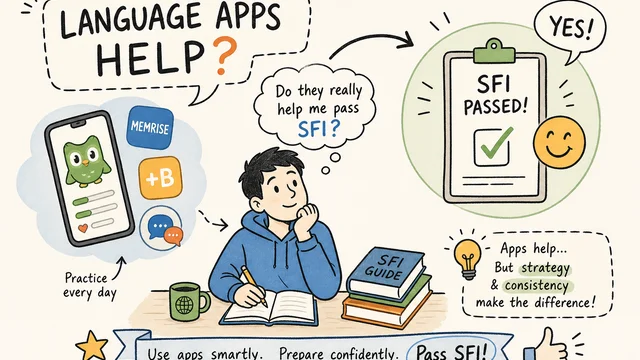
Artikulera is a mobile app developed with input from SFI teachers. It focuses exclusively on noun gender and the three forms it controls: articles, definite suffixes, and plural endings. The app includes 4,500 nouns, 30 learnable patterns designed to cover the majority of Swedish nouns, and a spaced repetition system drawing on memory research. It won't teach you the whole language, but it targets the grammar foundation that SFI consistently surfaces. For more on using apps in SFI preparation, read Do Language Apps Help You Pass SFI?
Free resources and a daily study plan
The best free tools for SFI prep
- SFA Sweden / Swedish for All — structured video lessons organized by SFI step, built by teachers
- Online Swedish (onlineswedish.org) — reading, listening, writing, and speaking practice aligned to national SFI exams
- Informationsverige.se — the free "Hello Sweden" digital course covering basic Swedish and Swedish society, designed for newcomers
- Swedish Radio easy language news — real listening practice at your current level
- Tyda.se — a Swedish-English dictionary with pronunciation, useful for building daily vocabulary
For app-based options, also see 6 Apps That Go Deeper Than Duolingo on Swedish Articles and the beginner roadmap in Learning Swedish: Where to Begin.
Building a daily habit that sticks
The best resource is the one you actually open every day. Fifteen to twenty minutes of focused, consistent practice will outperform a three-hour session on Sunday every single week. A rhythm that works: spend ten minutes on vocabulary and noun gender rules using Artikulera, then five to ten minutes on listening or reading from one of the free tools above. Weeks of consistency build real fluency in a way that occasional cramming never does.
Start your SFI preparation before the first class
The Swedish for immigrants program is one of the most practical investments a newcomer to Sweden can make. The administrative steps — eligibility, registration, and placement — are manageable once you understand what to expect. The language side rewards daily practice far more than last-minute effort, and the grammar concepts that teachers return to most consistently (noun gender, definite forms, plural endings) are learnable with the right tools and a steady routine.
Artikulera was built with SFI teachers specifically to address this foundation. It's free to download. Starting your grammar work before your first class is one of the most useful things you can do as you prepare for life in Sweden.

Practice Swedish en/ett with Artikulera
Spaced repetition, 30 rules of thumb, and 4,500+ nouns. Free to download.
Free · iPhone & iPad · iOS 17.6+
Frequently asked questions
- Who is eligible to enroll in SFI (Svenska för invandrare)?
- To enroll you generally need to be at least 16 years old, registered in a Swedish municipality, and have a valid residence permit. You should not already have basic Swedish knowledge, and most municipalities require a personnummer (some accept a samordningsnummer). Rules vary, so check with your local vuxenutbildning for specifics.
- How do I register for SFI in my municipality?
- Start on your municipality's adult education or vuxenutbildning registration page and apply online, in person, or by phone depending on local practice. After your application is reviewed you'll be invited to a placement interview or intake assessment that matches you to the correct course path.
- What documents should I bring when applying for SFI?
- The standard checklist includes a valid passport or government-issued ID, proof of your residence permit, and your personnummer or samordningsnummer. Previous school records aren't always required but can help place you at the right course level from day one.
- What are the SFI course levels and how is placement decided?
- SFI is split into four courses: A, B, C, and D, which map onto three study paths (1, 2, and 3) that reflect your educational background. Course A is for little or no prior schooling, Course B for literate learners new to Swedish, Course C is intermediate, and Course D roughly corresponds to B1 on the CEFR scale.
- How long do students have to finish SFI?
- Since January 2026 students generally have three years to complete the program. Extensions are available for illness, disability, parental leave, or when you're also working or studying alongside SFI.
- What does the SFI placement assessment look like?
- The intake is a structured conversation about your background, schooling history, and current exposure to Swedish. It's diagnostic — designed to place you on the right course path, not to screen you out.
- Which free tools can help me get a head start before SFI classes begin?
- Resources worth using: SFA Sweden / Swedish for All (video lessons by course level), Online Swedish at onlineswedish.org (reading, listening, writing practice), Informationsverige.se's Hello Sweden course, Swedish Radio easy-language news, and the Artikulera app for noun gender — a grammar area SFI teachers consistently prioritize. A short daily practice session before classes start makes the placement and early weeks noticeably easier.