Meet the Larsson family - an ordinary Swedish Tuesday
The best way to learn daily routines is to follow someone through their day. Meet Anna and Erik Larsson, and their children Maja and Linus, on a completely unremarkable Swedish Tuesday.
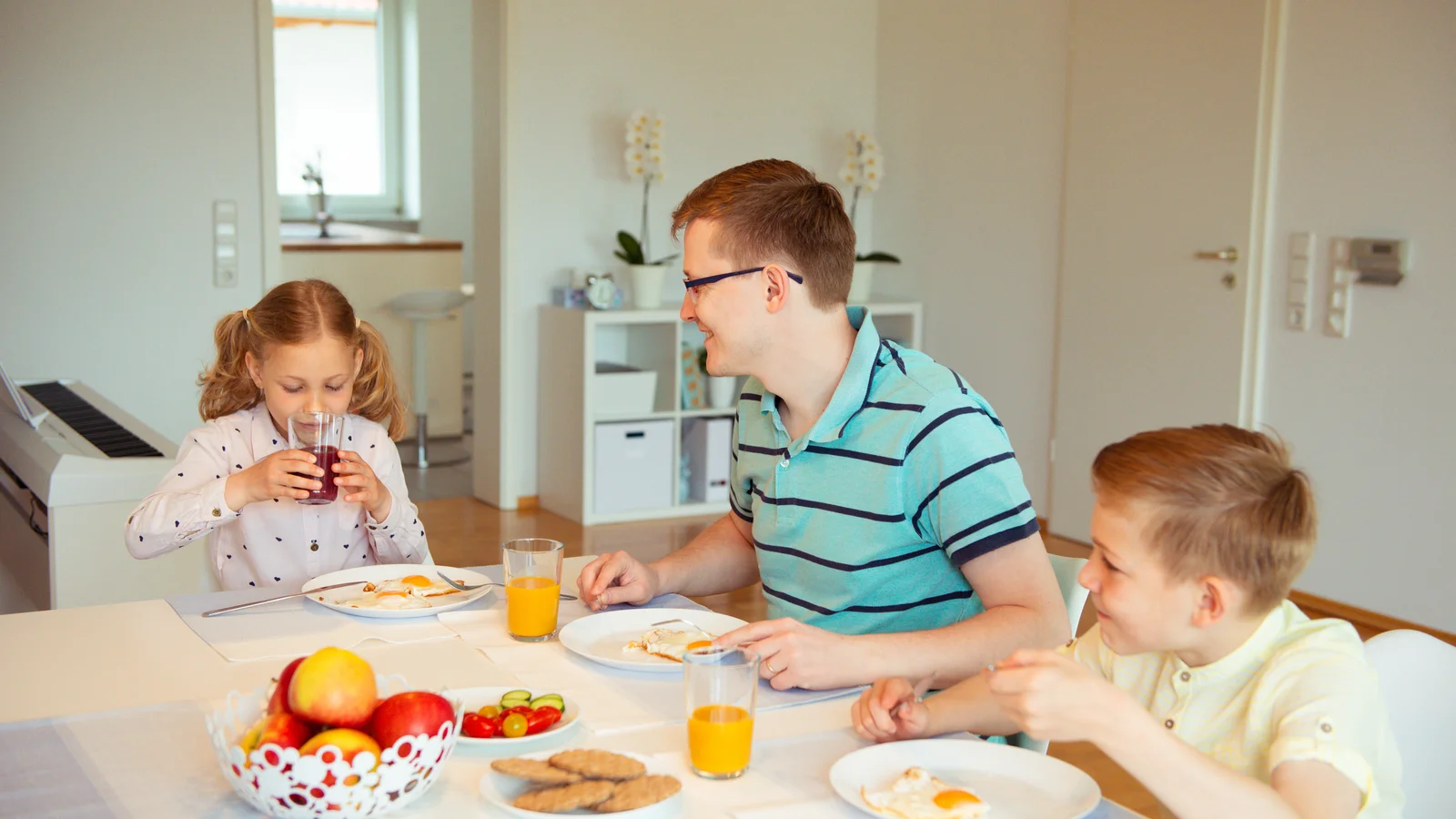
The Larsson family
Anna och Erik Larsson bor i ett hus utanför Stockholm. De har två barn: Maja som är åtta år och Linus som är fem. Anna jobbar som sjuksköterska och Erik jobbar på ett kontor i stan.
(Anna and Erik Larsson live in a house outside Stockholm. They have two children: Maja who is eight years old and Linus who is five. Anna works as a nurse and Erik works at an office in the city.)
Family vocabulary
Learn these nouns with their articles - you'll use them constantly. Notice that barn (child) is ett, even though children are people. It's the one major exception to the semantic rule that living beings are almost always en-words.
| Swedish | English | Definite form |
|---|---|---|
| en mamma | mom/mother | mamman |
| en pappa | dad/father | pappan |
| ett barn | a child | barnet |
| en son | a son | sonen |
| en dotter | a daughter | dottern |
| en familj | a family | familjen |
| ett hus | a house | huset |
| en lägenhet | an apartment | lägenheten |
Erik's Tuesday - telling time in Swedish
Swedish time has one genuine trap for English speakers: halv means "half past the previous hour", not half past the current one. Halv åtta = half eight = 7:30, not 8:30.
- Klockan är sex - It is 6:00
- Kvart över sex - 6:15 (quarter past six)
- Halv sju - 6:30 (half seven = half past six)
- Kvart i sju - 6:45 (quarter to seven)
- Klockan sju - 7:00
When asking the time: "Vad är klockan?" (What time is it?) or "Hur dags är det?" (What time is it? - more casual).
Anna and Erik's Tuesday - routine verbs
Swedish present tense is regular: most verbs add -r to the stem (or just use the stem if it ends in -r). Crucially, there is no person agreement - jag jobbar, du jobbar, han/hon jobbar all use the same form. This makes Swedish verbs far easier than most European languages.
| Verb phrase | English | Time |
|---|---|---|
| vaknar | wakes up | 06:30 |
| äter frukost | eats breakfast | 07:00 |
| går till jobbet | goes to work | 08:00 |
| jobbar | works | 08:00–17:00 |
| hämtar barnen | picks up the children | 17:00 |
| lagar middag | cooks dinner | 17:30 |
| äter middag | eats dinner | 18:00 |
| tittar på TV | watches TV | 19:00 |
| lägger sig | goes to bed | 22:00 |
Tuesday evening: tisdagsmys
At 18:00, the Larssons eat middag (dinner). Tonight is taco-tisdag - yes, Swedish families have largely adopted tacos as their tisdagsmys food. The tradition of mys (coziness as an intentional activity) is deeply Swedish: you don't just happen to feel cozy, you myser.
Familjen myser framför TV:n. Barnen väljer en film. Erik öppnar en påse chips. Anna dricker te.
(The family cozies up in front of the TV. The children choose a film. Erik opens a bag of chips. Anna drinks tea.)
Note the Swedish sentence structure: in the second and third sentences, the subject comes before the verb as expected. But if you start with an adverb - Ikväll tittar de på film (Tonight they watch a film) - the verb must still come second, pushing the subject after it. This is Swedish V2 word order.
When Tuesday goes wrong: VAB
Some Tuesdays, Linus wakes up with a fever. Anna calls in: "Jag kan inte komma in idag - jag VAB:ar." (I can't come in today - I'm home with a sick child.)
VAB (vård av barn - care of child) is a Swedish social insurance benefit that lets parents stay home when children are ill, with the state covering 80% of lost income. It has become a verb: att VAB:a, jag VAB:ar, jag VAB:ade. Sweden has among the highest rates of parental leave usage in the world - VAB is not an exception, it's part of the system.
Grammar summary
- En/ett: Learn nouns with their article. Exception to watch: ett barn (neuter despite being a person).
- Present tense: Add -r to the verb stem. No person agreement - jag jobbar = du jobbar = han jobbar.
- V2 word order: The verb is always second in a main clause. Adverb first? Invert subject and verb.
- Telling time: Halv = half past the previous hour. Halv åtta = 7:30.

Practice Swedish en/ett with Artikulera
Spaced repetition, 30 rules of thumb, and 4,500+ nouns. Free to download.
Free · iPhone & iPad · iOS 17.6+
Frequently asked questions
- What is 'tisdagsmys' in Swedish culture?
- Tisdagsmys - literally 'Tuesday coziness' - is the Swedish tradition of treating Tuesday evenings as a mini-weekend. The family gathers on the sofa, often with tacos (yes, Swedish tacos are their own thing), chips, and a TV series. The concept captures Sweden's broader culture of mys (coziness) as an intentional, recurring ritual, not something that just happens.
- What does 'VAB' mean in Swedish?
- VAB stands for 'vård av barn' - caring for a child. In Sweden, parents who stay home with a sick child can claim a state benefit called VAB-dagar (VAB days). The phrase 'jag VAB:ar' (I'm VAB-ing) is used as a verb in everyday speech. It reflects how deeply integrated parental support is in Swedish society - staying home for a sick child is normalized, not stigmatized.
- How do you tell time in Swedish?
- Swedish time uses a 12-hour clock in speech. The key structure: kvart i (quarter to), halv (half past the previous hour - confusing for English speakers!), kvart över (quarter past). So 7:30 is 'halv åtta' (half eight, not half seven). 'Det är halv åtta' = It's 7:30. Once you understand the halv system, the rest follows logically.
- What are common daily routine verbs in Swedish?
- The most useful routine verbs: vakna (to wake up), stiga upp (to get up), äta frukost (to eat breakfast), gå till jobbet (to go to work), hämta barnen (to pick up the children), laga mat (to cook), titta på TV (to watch TV), lägga sig (to go to bed). These are regular verbs in the present tense - conjugation is simple since Swedish doesn't change the verb form by person.